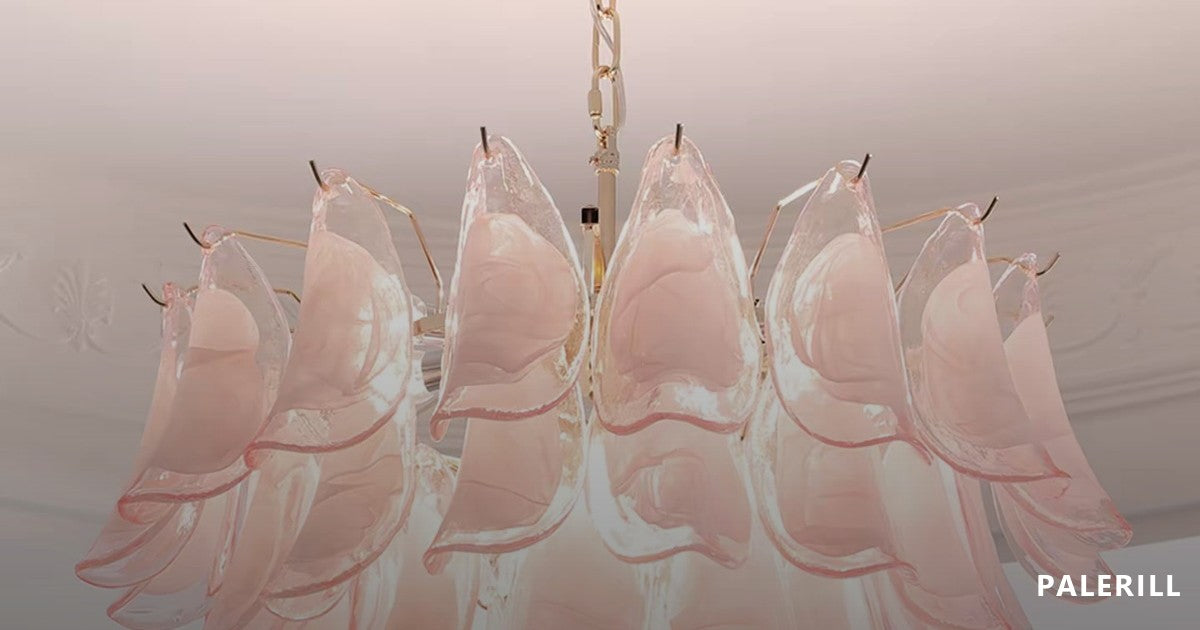
Most chandeliers can be hung from a sloped or vaulted ceiling. A hanging fixture is levelled by its ceiling canopy, so the pitch changes the head of the assembly, not the principle. What cannot be used on a slope is a flush or semi-flush light, because a flush body has no suspension to absorb the angle.
Which of our fixtures state that they suit a sloped ceiling
Of the 1,119 products live in our catalogue on 14 October 2026, 230 carry a slope field and state it either way. Two hundred and four say yes, eighteen say no and eight are marked not applicable, so just under nine in ten of the stated entries are usable on a pitch. The pattern behind those figures is simple. Every one of the 204 marked yes is a hanging chandelier on chain or wire suspension. Every one of the 18 marked no is a fixture that mounts flat, being sixteen flush ceiling lights and two ceiling fan lights. The eight not-applicable entries are seven wall lights and one table lamp, none of which touch the ceiling at all. The other 889 products in the range carry no slope statement on the page at all, which means the property is unpublished for them rather than refused.
| What the listing states | Products | Slope use | Why |
|---|---|---|---|
| Yes, chain or wire suspension | 204 | Usable with a slope-ready canopy | The suspension pivots and the canopy closes the gap |
| No, flush ceiling-mounted | 16 | Not usable | The body sits square against the plaster |
| No, ceiling fan light | 2 | Not usable | The housing is fixed square to the ceiling |
| Not applicable, wall mounted | 7 | Not applicable | No ceiling connection at all |
| Not applicable, freestanding | 1 | Not applicable | No ceiling connection at all |
| No slope field published | 889 | Confirm before ordering | The field is absent from the product page |
The canopy is the part that decides it
The canopy is the shallow plate that covers the ceiling outlet box and carries the ring that the chain or wire passes through. On a flat ceiling it sits parallel to the plaster. On a sloped ceiling it meets an inclined plane, and one of two things happens. Either the canopy is built to tilt and close against the pitch, or it rests on one edge with the opposite edge left open to the room, which is visible from below. Two hundred and one of the 204 chandeliers that state the field give the suspension length only as adjustable, and none of them publishes a maximum pitch, so the rated range has to come from us in writing before you buy. Treat an angle quoted anywhere else as the canopy maker's figure rather than ours.
Why flush and semi-flush lights fail on a slope
Flush and semi-flush lights are the group that fails, and the reason is geometric. A flush body is designed to sit against a flat surface, so its back plate is square to the housing. Put that plate on a ceiling that falls at any angle and the housing tilts with the plate, opening a wedge on the high side and closing hard on the low side. The gap stays visible from normal eye level. Semi-flush is not a fix either, because the short stem lifts the housing off the plaster while the canopy is still cut square, so the same wedge appears at the ceiling line. The data agrees with the geometry. Of the 18 products in our range that state they are not slope adaptable, sixteen are flush ceiling-mounted and two are ceiling fan lights, and not one of them has a chain or wire suspension.
Setting the drop on a raked ceiling
On a raked ceiling the drop is measured from the low side, because the low side is what limits clearance under the fixture. Take the ceiling height at the point directly above the fixture, not the average of the room and not the ridge, then subtract the clearance you want to keep under the lowest crystal. What is left is the budget for the body plus chain, wire or cord plus canopy. Riding a fixture up towards the ridge borrows height that is not above it, so a canopy that looks short on paper can still foul headroom at the low edge. Keep the walking clearance generous. The trade figure designers use is 2.1 m (6 ft 11 in) to the lowest point of the fixture, which is a convention rather than a code requirement. The same arithmetic for a two-storey void is set out in the stairwell chandelier drop and clearance guide.
| Measurement on a raked ceiling | Where to take it | What it decides |
|---|---|---|
| Height at the fixing point | Directly above the canopy, on the low side of the slope | Drop budget for body, suspension and canopy |
| Clearance under the lowest point | Floor to the lowest crystal | Whether the fixture fouls the walking line |
| Pitch across the canopy run | Across the width the canopy sits on | Whether the canopy can close against the plaster |
| Outlet box position | Centre of the outlet, not the centre of the room | Whether the fixture hangs over the table or the void |
What to send us before you order
There is no standard form for this, so the quickest route is a short set of measurements and photographs sent before you order. What we need is not a description of the ceiling but the numbers that decide the canopy and the drop, and the list below is the set that has answered every slope enquiry we have handled. Send them in millimetres and in feet and inches, because the two units catch different mistakes: a millimetre figure with a misplaced decimal reads as a plausible inch figure. The clearance you are keeping is usually quoted as 2.1 m (6 ft 11 in) to the lowest point, so give that reading in the same form. If the ceiling is plasterboard over timber, say so, and if it is a raked slab or a beam, say that as well, because the fixing differs. The load side of the same decision is covered under what a large crystal chandelier weighs and what a ceiling has to carry.
- Ceiling height at the fixing point, in millimetres and in feet and inches.
- The pitch of the ceiling plane across the run the canopy sits on.
- The distance from the fixing point to the nearest high wall or ridge.
- The clearance you want to keep under the lowest point of the fixture.
- Two photographs: one square-on at ceiling level, one from the floor looking up.
- A note on whether the outlet box is rated for the fixture weight.
When a chandelier on a sloped ceiling is not the right choice
Skip a slope installation when the only fixture that suits the room is one of the 18 flat-mount products in our range, because that wedge gap cannot be closed without furring the ceiling to a flat patch, and shimming a canopy is not a fixing method. Skip it when the structure above is a raked slab with no framing at the fixing point, because the load still has to go somewhere. Skip it when nobody can confirm the pitch, the outlet box rating and the canopy before production, because the fixture is built to the measurements you send. In those cases a wall light, a floor lamp or a fixture hung from a lower flat section does the same job with none of the risk. Sizing for a flat ceiling is covered in the foyer chandelier size guide, and the foyer chandelier collection shows the hanging formats we build for tall rooms.
Numbers and sources
Every figure in this article comes from one of three places. The catalogue figures are 1,119 live products, 8,222 variants, the 230 products that state a slope field, the split of 204 yes, 18 no and 8 not applicable, the 16 flush ceiling lights and two ceiling fan lights behind the eighteen, the seven wall lights and one table lamp behind the eight, the 201 of 204 adjustable wire lengths, the three stated maxima of 3 m (9.8 ft) twice and 1.5 m (4.9 ft) once, and the price band of $95 to $59,800 with a median entry of $1,412.50 and a median top of $6,684.50. All of them are recomputed from our own Shopify catalogue export of 14 October 2026. The 2.1 m (6 ft 11 in) clearance is a trade convention, not a standard, and no measurement of ours sits behind it. Unit conversions are arithmetic at 25.4 mm to the inch and 304.8 mm to the foot.
| Figure | Value | Source | Nature |
|---|---|---|---|
| Live products | 1,119 products / 8,222 variants | Shopify catalogue export, 14 October 2026 | First-party, recomputed |
| Slope field stated | 230 of 1,119 products | Same export, product pages | First-party, recomputed |
| Stated split | 204 yes / 18 no / 8 not applicable | Same export, product pages | First-party, recomputed |
| Not-slope products | 16 flush ceiling lights, 2 ceiling fan lights | Same export, product pages | First-party, recomputed |
| Not-applicable products | 7 wall lights, 1 table lamp | Same export, product pages | First-party, recomputed |
| Wire length | 201 of 204 adjustable; maxima 3 m (9.8 ft) and 1.5 m (4.9 ft) | Same export, product pages | First-party, recomputed |
| Price band | $95 to $59,800; median entry $1,412.50; median top $6,684.50 | Same export, product pages | First-party, recomputed |
| Walking clearance | 2.1 m (6 ft 11 in) to the lowest point | Trade convention | Not a standard, not measured here |
| Maximum slope pitch | Not published on our listings | Our own product pages | Confirmed in writing per order |
| Unit conversions | 25.4 mm to the inch, 304.8 mm to the foot | Arithmetic | Definitional |
A slope-ready canopy changes where a fixture may be mounted. It does not change what it looks like from below, what light it gives, or whether a search engine will show the page. Structural and electrical work belongs to a qualified electrician on site, and the clearance figure above is design guidance rather than a substitute for that advice.