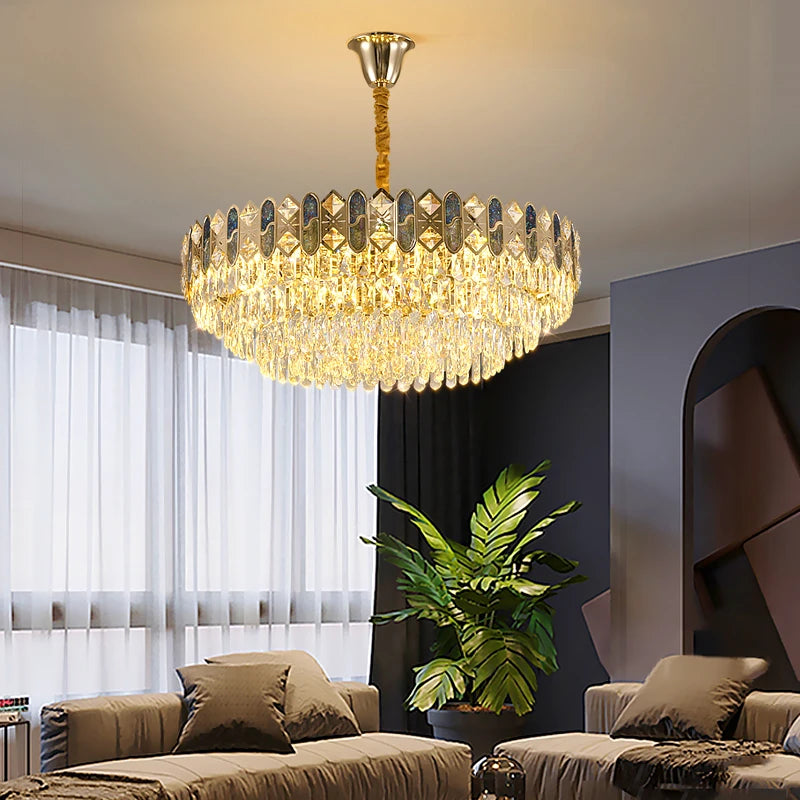
The shade material decides how a chandelier throws light, and it matters more than the frame. Crystal keeps the sparkle and the hard shadows, glass spreads the same output evenly, and fabric softens everything at the cost of some output and all of the sparkle. Choose by the glare you can live with and the cleaning you will actually do.
Why the shade decides the room, not the frame
Light leaves a chandelier through the shade, so the shade sets both the direction and the contrast of everything the fixture puts into the room. A frame only holds the light sources in place; a 60 cm (23.6 in) canopy and a 12-arm body change nothing about how the light behaves once it has passed the diffuser. That is why two chandeliers with the same lamp count, the same 3000 K colour temperature and the same measured lumens can read completely differently in the same room: one delivers a thousand small bright points, the other delivers one soft field. The material also sets the maintenance calendar, because dust shows differently on faceted crystal, on clear glass and on a fabric drum, and cleaning a 12-arm fixture takes about 90 minutes The guide to K9 crystal, alabaster and brass covers the body materials, and cleaning a crystal chandelier covers the method in full.whether or not the material is the reason you are up the ladder.
Crystal shades: maximum sparkle, hardest edges
Faceted crystal does not diffuse light, it refracts it, so every facet becomes a small bright source with a sharp edge. In a room that is read from below, which is every dining room and most foyers, that produces the glitter people mean when they say a chandelier looks expensive, and it also produces glare at any eye height that comes close to the fixture. Crystal works when the fixture hangs high enough that the facets sit above the eyeline of anyone seated, which in practice means above 75 cm (29.5 in) over a table and above 210 cm (82.7 in) over a floor. It is a poor choice in a low room where the fixture is seen at eye level from a sofa, and it is a poor choice where the wall behind is glossy, because the facet pattern repeats on the wall and reads as noise.
Glass shades: clear, opal and ribbed are three different products
Glass is the middle ground, but the word covers three products that behave differently, and a listing that says glass without saying which one has told you almost nothing. Clear glass passes light with almost no diffusion, so it keeps much of the sparkle of crystal while softening the edges; opal or frosted glass diffuses hard, which removes glare and also removes the sparkle that buyers were paying for; ribbed or fluted glass sits between the two and throws a pattern rather than a point. Of the 557 chandelier listings on our own store, 507 mention glass and 464 mention crystal, so both words carry a product range behind them. The same fixture body can be sold with any of the three, so compare the shade, not the frame. Ask which one is on the fixture before comparing prices, because the delivered look changes more between clear and opal on the same body than between two different bodies with the same shade.
| Glass type | Diffusion | Sparkle retained | Glare at eye level | Best room |
|---|---|---|---|---|
| Ribbed or fluted | Moderate | Medium | Medium | Dining, living room, anywhere a pattern is welcome |
| Opal or frosted | Strong | Low | Low | Bedroom, low ceiling, seating close to the fixture |
Fabric shades: softest light, real cost in output
Fabric diffuses hardest of the three and removes glare almost completely, which is why drum and empire shades dominate hotel bedrooms and why they are the default answer for anyone who finds crystal too busy. The cost is double: output drops because the textile absorbs and scatters rather than transmits, and the sparkle that a crystal body exists to produce disappears behind the drum. A fabric-shaded chandelier is therefore a different product from the same frame with crystal cups, not a styling variation. Fabric also sets a maintenance rule the others do not: textile collects cooking grease in a kitchen and dust in a bedroom, spot cleaning works and washing does not, and a shade that has yellowed cannot be restored. Only 36 of the 557 chandelier listings on our store mention fabric, so a fabric version is usually a special-order conversation. In a kitchen with a gas hob, or in any commercial space with a fire specification, the fabric option needs documented treatment before it can be specified.
| Material | Output through the shade | Glare | Cleaning interval | Fails when |
|---|---|---|---|---|
| Clear glass | Close to crystal | High close up | 6 months | Kitchen grease films the surface and cannot be polished out |
| Opal glass | Lower, and the loss is not published by most makers | Low | 3 months, because dust shows on a matte surface | Buyer wanted sparkle and got a soft field |
| Fabric | Lowest; textile absorbs and scatters | Lowest | 3 months vacuum, spot clean only | Kitchen, humidity, or a commercial fire specification |
What the catalogue actually publishes
The gap between what buyers compare and what listings state is measurable on our own store. On 31 October 2026 the catalogue carried 1,813 active listings, of which 557 are typed as chandeliers. Of those 557, 394 state a shade material value at all, so 163 chandelier listings describe the frame and the finish while leaving the diffuser unstated, and that 29 percent is the number a buyer should treat as a prompt to ask rather than as a gap in the range. Word frequency shows where the catalogue sits: 464 of the 557 mention crystal, 507 mention glass, and only 36 mention fabric anywhere in the description. The practical reading is that the range is overwhelmingly open crystal and glass, that fabric is a special-order conversation rather than a catalogue option, and that a buyer comparing on price alone is comparing bodies without comparing the one part that decides how the room will look.
Sizing still applies, and the shade adds to it
A shade does not change the diameter rule, but it does change the number the rule has to clear, because a drum or a glass cup adds width on every side of the body. Of 278 chandelier listings that publish a diameter range, 10 state an impossible range, and across the remaining 268 the configurable diameters run from 20 cm (7.9 in) to 280 cm (110.2 in), with a median upper bound of 100 cm (39.4 in); that range is what the factory can build, not what a room needs. Where a shade is specified, add its projection twice to the body diameter before the proportion test against the narrowest wall, and add it once to the body height before checking the drop against the 210 cm (82.7 in) circulation clearance. A 100 cm body with 10 cm shades on each side is a 120 cm fixture in the room, which is the difference between passing and failing one third of a 3.6 m (11 ft 10 in) wall.
Cleaning schedules differ by material
The material sets how often the ladder comes out, and the 12-month figure that circulates for crystal is a convention for a land-locked room with forced air, not a rule that survives a kitchen or a coastline. Crystal and clear glass are cleaned the same way: a lint-free cloth, lukewarm water with a drop of mild soap, and drying before the water spots set, with the fixture switched off and cool. Opal glass is less forgiving because a matte surface holds film and cannot be polished back, so it wants a shorter interval and no abrasive. Fabric wants a vacuum on the lowest setting with a brush head, spot cleaning with a foam cleaner, and no immersion; a fabric shade that has been washed will lose its shape and its fire treatment at the same time.
When a shade is the wrong answer
Four cases where the honest answer is to specify no shade at all are worth stating, because a shade is usually sold as an upgrade. A decorative fixture built around exposed candle bulbs loses its proportion when a drum is added, and a shade over that kind of body is not recommended: the result reads as a lampshade on a chandelier. A commercial interior with a published fire specification needs documented treatment on any textile, and a maker who cannot supply the test data should not be asked to supply the shade. A bathroom, a covered porch or any space with sustained humidity rules out fabric and unsealed fabric-lined glass, so check the IP rating of the fitting. And where the room is short of light rather than glare, a 120 cm body that is already under-lit does not recover what 10 cm of drum per side absorbs.
FAQ
Does a fabric shade make a chandelier dimmer? Yes. The textile absorbs and scatters output instead of transmitting it, so the same lamps deliver less light into the room. Ask the maker for measured lumens at the diffuser rather than a percentage.
Can I buy shades separately for a fixture I already own? Only if the fitter type and the arm spacing are known. Candelabra fittings, clip-on fittings and uno fittings are not interchangeable, and arm spacing decides whether a 15 cm (5.9 in) shade collides with its neighbour.
Is crystal just glass with a brand name? No. Crystal is glass with a higher refractive index and a defined cut, which is why it splits light into points instead of passing it. The difference is visible at the fixture, not in a photograph.
Which material suits a low ceiling? Opal glass or fabric, because both remove the glare that a low hang creates. Crystal at eye level is the combination that buyers regret.
Numbers and sources
| Number as written | Source | Nature |
|---|---|---|
| 394 of 557 chandelier listings state a shade material value | Same snapshot, case-insensitive match for the string `shade material` in each description | First-party, recomputed mechanically |
| 163 chandelier listings leave the diffuser unstated | Arithmetic: 557 minus 394 | Arithmetic on the same snapshot |
| 464 mention crystal; 507 mention glass; 36 mention fabric | Same snapshot, whole-word match inside each description | First-party, recomputed mechanically |
| 278 chandelier listings publish a diameter range; 20 cm to 280 cm; median upper bound 100 cm | Same snapshot, parsed from the diameter range sentence in each description, after excluding 10 listings whose stated range is physically impossible (lower bound under 20 cm or upper bound over 300 cm) | First-party, recomputed mechanically |
| 3000 K colour temperature | Illuminant chromaticity defined in ANSI C78.377 | Published standard, US |
| Circulation clearance of 210 cm (82.7 in) to the floor | Installation practice in US and European residential work | Trade convention, not a standard |
| 75 cm (29.5 in) above a dining table to the lowest crystal | Clearance convention stated on our own listings | Trade convention, not a standard |
| Proportion limit at one third of the narrowest wall | Design rule of thumb in general use | Trade convention, not a standard |
| 12 months for crystal, 6 months for clear glass, 3 months for opal glass and fabric | Cleaning intervals used in our own installation notes | Trade convention, not a standard |
| 90 minutes to clean a 12-arm fixture | Observed on our own 12-arm builds during finishing | First-party observation, not a measured study |
| 10 cm (3.9 in) of added projection per side for a drum shade | Typical drum projection across the shades we are asked to quote | Trade convention, not a standard |
| cm, in and kg conversions | Unit conversion at 1 in = 2.54 cm | Arithmetic |
Disclaimer
The catalogue counts describe the listings as they stood on 31 October 2026 and will drift as the range changes. Word-frequency counts record whether a word appears in a description, not how a fixture is built, so they are a statement about published information rather than about product composition; a listing that never uses the word fabric can still be quoted with a fabric shade. No transmission percentage, lumen figure or glare rating is claimed anywhere on this page, because none of them can be established without a measurement on the actual fixture, and a maker who quotes one without a test should be asked for the test. Cleaning intervals are conventions for a normal indoor room and shorten in kitchens, coastal air and smoking environments. Whether a specific shade is acceptable in a commercial or rented interior is a question for the authority having jurisdiction, not for a supplier.
Related reading: a formed glass body is judged on how it was made and how it was coloured, not on the word glass in the listing. Art glass chandeliers: what you are buying sets out the three forming methods, the weight each thickness adds per square metre, and the questions that make a supplier commit to a batch.