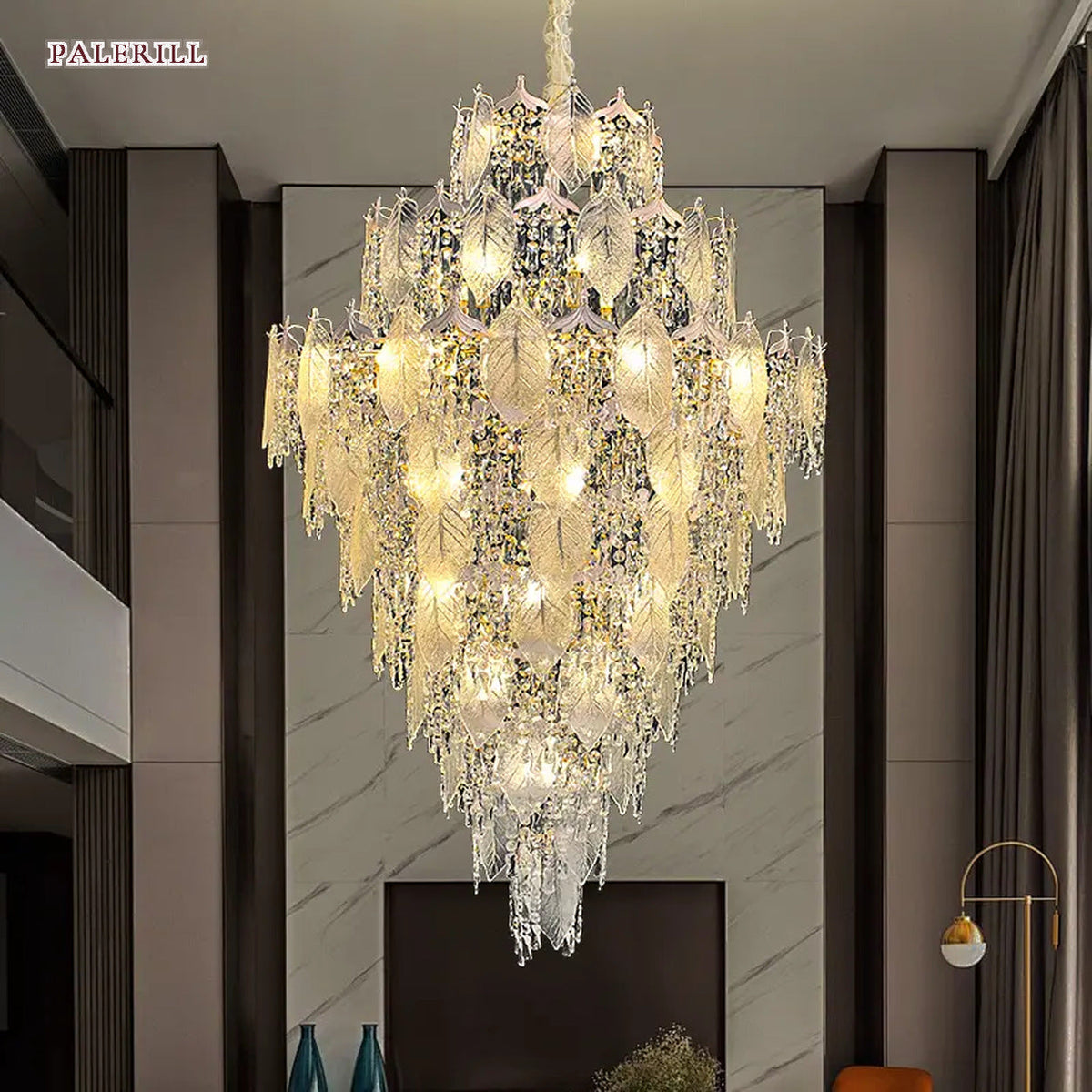
A crystal chandelier hangs from one of three things: a chain, a rigid rod, or a steel cable. The chain adjusts by removing links, the rod is cut to a fixed length, and the cable adjusts at a gripper. All three hand the load to the ceiling box, which is the part that decides whether the fixture is safe.
What each of the three suspension types does
A chain is a run of welded or openable links that carries the fixture weight in tension and lets the drop change in steps of one link. A rod is a rigid tube, threaded at both ends, that gives a fixed straight drop and does not swing; it is cut on site, so the length is decided once. A cable is steel wire rope running through a gripper or a tensioner, adjusted by releasing the gripper rather than by cutting. Chain is the traditional answer for crystal, because the fixture can be raised or lowered by one person with two pairs of pliers. Cable suits a minimal fixture and a multi-drop composition. A rod sits between the two: rigid, quiet in a draught, and the hardest of the three to adjust once the ceiling is closed. The practical difference is what a 2 in (51 mm) error costs. On a chain it costs an hour; on a rod it costs a new rod.
| Suspension | How the drop changes | Suits | Limitation |
|---|---|---|---|
| Chain | Remove or add links, one link at a time | Crystal, traditional and multi-arm fixtures | Visible links, can swing, canopy has to hide the splice |
| Rod | Cut to length before hanging, no adjustment afterwards | Straight rigid drops over an island or table | A wrong length means a new rod, not a shorter one |
| Cable | Release the gripper and re-tension by hand | Minimal fixtures, multi-drop clusters | Needs a rated anchor and the matching gripper |
How to shorten a chain on a chandelier
Shorten a chain from the ceiling end, not the fixture end, so the canopy still covers the box and the loop at the fixture stays intact. Switch the circuit off at the breaker, not only at the wall switch, because a chandelier position can be fed by two switch legs. Lower the fixture onto a padded table with a second person before any link is opened. On a welded-link chain nothing opens by hand: a link is cut with a chain breaker or two pairs of pliers, and the cut end is closed with a connecting link rated for the same load. On a chain with openable links, one connector link is opened instead. Then the conductor has to be shortened as well, and that is a re-termination at the box or inside the canopy, never a twist-and-tape joint hanging in mid-air. Leave 150 mm (6 in) of conductor inside the canopy for that joint, which is a working practice rather than a rule.
- Isolate the circuit at the breaker and confirm the fixture is dead at the canopy, not at the switch.
- Take the fixture down onto a padded surface, or support its weight from below before any link is opened.
- Choose the removal point at the ceiling end, leave the fixture-end loop and the canopy untouched.
- Cut or open the link, close the new end with a rated connecting link, and check that the canopy still covers the box opening.
- Shorten the conductor at the box or in the canopy, re-terminate, then hang and measure the drop from the finished floor.
| What is removed | What changes | What has to be checked |
|---|---|---|
| Two links at the ceiling end | Drop falls by the length of those links | Canopy still covers the box and the splice |
| The fixture-end loop | Drop falls by the loop, the canopy is left floating | Canopy has nothing left to close against |
| Link plus conductor | Drop falls, the cord is now too long | Re-termination inside the canopy, never in the chain |
How to extend a chain and the wire that has to follow
Extending is the same job in reverse, with one addition: the conductor has to grow with the chain, and there is no accepted way to splice a cord in the middle of a run. Buy chain of the same link size and finish, because a second chain of a different gauge will not sit straight with the first. Add a length of flexible cord of the same core count and temperature rating, and make the joint inside a listed box or inside the canopy, where it can be opened and inspected. A joint hidden between two links is the failure that shows up a year later as a flicker. Keep the total drop inside the clearance the room allows: 84 in (213 cm) of walking clearance under a fixture in a circulation path, and 30 to 36 in (762 to 914 mm) above a tabletop, both trade conventions rather than code.
| Room situation | Drop allowed above the reference point | Where the number comes from |
|---|---|---|
| Walkway, 8 ft (2.44 m) ceiling | 12 in (305 mm) from ceiling to lowest point | 84 in (213 cm) clearance convention |
| Walkway, 9 ft (2.74 m) ceiling | 24 in (610 mm) from ceiling to lowest point | Same convention, taller ceiling |
| Dining table, any ceiling | 30 to 36 in (762 to 914 mm) above the tabletop | Trade convention, measured from the table |
Where the load actually goes
Three parts carry the weight and only one of them is structural. The ceiling box is the anchor, and in US wiring an outlet box used only for lighting has to support a luminaire of at least 50 lb (22.7 kg) unless it is listed and marked for a different figure, which is the rule in NEC 314.27(A)(2). A box marked 35 lb (15.9 kg) carries less than that. The chain, rod or cable transmits the load in tension and adds its own weight to the total. The canopy covers the joint and carries nothing structural. This is why the rated working load of the suspension matters as much as the fixture weight: a decorative chain is rated by its maker, not by its diameter, so ask for the working load in writing rather than judging by eye. What a large crystal chandelier weighs sets out the same load path from the other end, starting from the fixture rather than from the fixing.
| Total hanging weight | What the ceiling needs | Who confirms it |
|---|---|---|
| Up to 6 lb (2.7 kg) | Listed ceiling box fixed to framing | Electrician reads the marking |
| 6 lb to 35 lb (2.7 kg to 15.9 kg) | Box marked for that load, on framing | Electrician, with the fixture weight in hand |
| 35 lb to 50 lb (15.9 kg to 22.7 kg) | Box marked for the load, fixed to structure | Electrician checks the marking inside the box |
| Above 50 lb (22.7 kg) | Independent support to structure, per NEC 314.27(A)(2) | Structural fixing designed for the load |
What our own catalogue publishes about suspension
Suspension is the least documented field in a crystal chandelier listing, and our own catalogue shows it. Of 1,381 active listings on 27 October 2026, 230 publish a hanging-method field, and 204 of those 230 state ceiling mounted with chain or wire suspension. The same 230 publish a wire length, while 576 listings mention customisation of some kind. The gap matters at the point of purchase: a buyer comparing two fixtures of the same diameter cannot tell from the page whether the drop is adjustable, whether the chain can be shortened, or what the canopy will cover. Ask for the working load, the maximum and minimum drop, and the canopy diameter in writing before the order, and treat a page that omits them as incomplete rather than as evidence that the fixture is fixed.
| Field | Listings stating it | Share of the catalogue |
|---|---|---|
| Hanging method | 230 | 16.7 per cent |
| Chain or wire suspension, of those 230 | 204 | 88.7 per cent of the stated field |
| Wire length | 230 | 16.7 per cent |
| Customisation mentioned in the description | 576 | 41.7 per cent |
| Hanging weight | 10 | 0.7 per cent |
Sloped ceilings, offset canopies and swag hooks
A sloped or vaulted ceiling changes the canopy, not the chain. The fixture has to hang plumb while the ceiling runs at an angle, so the canopy is either a slope version with a hinged or angled face, or a swivel joint is fitted between the chain and the fixture. Once the pitch passes about 15 degrees, the chain leaves the canopy at an angle, the canopy sits proud of the plaster on one side, and the load pulls sideways on the box rather than straight down. A swag hook is the other common answer, and it is a real one: the chain runs across the ceiling to a hook near the fixture position, which is how a chandelier is moved to the centre of a table when the box is not centred. The hook then carries the load, so it is fixed to structure and rated, not screwed into plaster.
| Ceiling condition | Part that changes | What to check before ordering |
|---|---|---|
| Sloped or vaulted, 15 degrees or more | Slope canopy or swivel joint | Canopy rated for the pitch, chain leaves plumb |
| Box off centre by more than 12 in (305 mm) | Swag hook or offset ceiling plate | Hook fixed to structure and rated |
| Flat plaster, no joist within reach | Box with adjustable braces | Box listed and marked for the load |
| Beam or coffered ceiling | Longer canopy or a ceiling plate | Canopy clears the beam face |
Rod and cable: when they beat a chain
A rod wins when the fixture must not move. Over a kitchen island, a chain that swings when a door closes reads as a defect, and a rigid rod removes the movement completely. A rod also holds a linear fixture level along its whole length, which a single chain cannot do. Cable wins when the fixture is meant to look as if it floats, and when a cluster of drops has to be levelled individually: each cable is set at its own gripper, so a composition of five drops can be tuned to within 5 mm (0.2 in) of each other. Both cost more to change later than a chain. A rod cannot be shortened by hand, and a cable system depends on the anchor and gripper that came with it, so a replacement part has to match the system rather than the look. Neither solves the servicing problem above 12 ft (3.66 m), which the guide to lift systems treats as a mechanism choice rather than a suspension choice.
| Property | Chain | Rod | Cable |
|---|---|---|---|
| Field adjustable | Yes, link by link | No, cut once | Yes, at the gripper |
| Movement under draught | Swings | Rigid | Slight sway |
| Service access at height | Fixture can be lowered | Fixture is fixed | Release and lower |
| Common failure to check | Open or worn link | Thread engagement | Gripper slip at the anchor |
What to measure before ordering a custom drop
Six measurements decide a made-to-measure suspension, and all of them are taken with a tape. Measure the ceiling height from the finished floor to the fixing point, not to the slab, because a ceiling rose or a medallion sits below the slab. Measure the floor-to-tabletop height if the fixture hangs over a table, and measure the horizontal offset between the box and the point where the fixture should hang, because anything beyond 12 in (305 mm) needs a swag hook or an offset plate rather than a longer chain. Note the joist direction and spacing, normally 16 in (406 mm) or 24 in (610 mm) on centre in US timber ceilings, a framing convention rather than a code figure. Photograph the marking printed inside the ceiling box. Body height and total hanging height are different numbers, and the guide to fixture height against hanging height puts a figure on each before the tape comes out.
| What to send | Why the maker needs it | What goes wrong without it |
|---|---|---|
| Ceiling height to the fixing point | Sets the maximum drop | Chain arrives long and has to be cut on site |
| Floor to tabletop, if over a table | Sets the clearance | Fixture hangs into the sightline |
| Offset from box to fixture centre | Decides swag or offset plate | Fixture hangs off centre over the table |
| Photo of the box marking | Confirms the load allowance | Box rated below the fixture weight |
| Supply voltage and frequency | Our fixtures are built for 100 to 240 V at 50 or 60 Hz | Wrong driver or lamp supplied |
When a chain is not the right choice
A chain is not the right choice under a ceiling of 8 ft (2.44 m) where a walking clearance of 84 in (213 cm) leaves 12 in (305 mm) for canopy, suspension and body together, because the body alone usually exceeds that and shortening the chain cannot fix a body that is too tall. It is not the right choice over a kitchen island where the fixture must stay still, or in a room with a through draught and a light fixture that will swing against a wall. It is not the right choice on a sloped ceiling without a slope canopy or a swivel, and not on a plaster ceiling with no framing within reach of the box, where the fixing has to be rebuilt first. Above 50 lb (22.7 kg) the suspension is no longer the deciding part at all: the ceiling needs engineered support, and the chain is only as good as the anchor above it.
FAQ: chandelier suspension
Can I shorten a chandelier chain myself? Yes, if the fixture can be taken down and the conductor can be re-terminated properly. Opening a link with two pairs of pliers is the easy half; the half that fails is the cord, which has to be shortened at the box or inside the canopy and re-terminated rather than twisted and taped.
Can a chain be lengthened instead of replaced? Yes, with chain of the same link size and finish, plus a longer cord of the same rating. The joint belongs in a listed box or in the canopy. A splice sitting between two links is not accessible for inspection and is where intermittent faults come from.
How much weight will a chain hold? The rated working load is set by the chain maker and is not a function of diameter alone, so it has to come in writing with the fixture. What the ceiling box will hold is a separate question, and in US wiring it is 50 lb (22.7 kg) for a lighting outlet unless the box is listed and marked for more, under NEC 314.27(A)(2).
Does a chandelier have to hang from a chain? No. A rod gives a fixed straight drop and no movement, and a cable gives an adjustable drop with a minimal look. Crystal fixtures are usually chained because the drop so often changes between the showroom and the room, and because a chain can be adjusted without new parts.
What if the ceiling box is not where the fixture should hang? A swag hook or an offset ceiling plate takes the chain across the ceiling to the right point, with the load transferred to a rated hook fixed to structure. Beyond about 12 in (305 mm) of offset, plan the ceiling work rather than the hardware. The sloped and vaulted ceiling guide covers the same problem on a pitched surface, and the crystal chandelier range is where the drop of each model is quoted per size.
Numbers and sources
| Number as written | Source | Nature |
|---|---|---|
| 1,381 active listings | Shopify catalogue pull on 27 October 2026 (`catalog-20261027.json`), products with status active | Direct read of the store backend |
| 230 listings with a hanging method, 204 of them chain or wire suspension, 16 flush, 7 wall, 2 ceiling mounted, 1 freestanding | Same snapshot, value parsed from the hanging-method field of the description text | First-party, recomputed mechanically |
| 230 listings with a wire length, 576 mentioning customisation, 10 stating a hanging weight | Same snapshot, substring match on the description text | First-party, recomputed mechanically |
| 16.7, 88.7, 41.7 and 0.7 per cent | Arithmetic on the counts above, against 1,381 and against 230 | Arithmetic |
| 50 lb (22.7 kg) threshold for independent support | NEC 314.27(A)(2), ceiling outlets used exclusively for lighting | Published electrical code requirement, not a measurement of your ceiling |
| 35 lb (15.9 kg) box marking | Load figure printed on ceiling boxes sold in the US | Product marking convention |
| 84 in (213 cm) walking clearance | Height at which an adult walks under a fixture without ducking | Trade convention, not a code figure |
| 30 to 36 in (762 to 914 mm) above a tabletop | Dining and kitchen hanging convention | Trade convention, not a standard |
| 12 in (305 mm) offset before a swag or offset plate is needed | Working practice among installers | Trade practice, not a standard |
| 16 in (406 mm) and 24 in (610 mm) joist spacing | Framing practice in US timber floors and ceilings | Trade convention, not a code figure |
| 8 ft (2.44 m), 9 ft (2.74 m), 10 ft (3.05 m) ceilings | Common ceiling heights in US and European housing | Product convention, converted at 1 ft = 0.3048 m |
| 100 to 240 V at 50 or 60 Hz | Supply our fixtures are wired for, as stated in each listing | Product specification |
| Unit conversions | 1 in = 25.4 mm, 1 lb = 0.4536 kg, 1 ft = 0.3048 m | Arithmetic |
Disclaimer
Every figure above carries a source and a nature, and the catalogue counts describe the listings on 27 October 2026 rather than the range as it will stand next month. The electrical figures are quoted from published code text and from box markings; they are not a measurement of any particular ceiling, and local amendments differ by jurisdiction. The clearance, offset and joist figures are trade conventions and practices, not standards, and no measurement of ours sits behind them. Nothing here is a structural or electrical assessment: whether a given ceiling can carry a given fixture, and whether a given chain is rated for it, is decided by a licensed electrician or an engineer who has seen the framing and the hardware, and no fixture should be ordered against this page alone.
Related reading: the point where a chain or a rod meets the ceiling is closed by a cover rather than by the suspension part itself, and the canopy that covers that point sets out which opening each diameter closes and when a flat plate has to be replaced with a swivel.