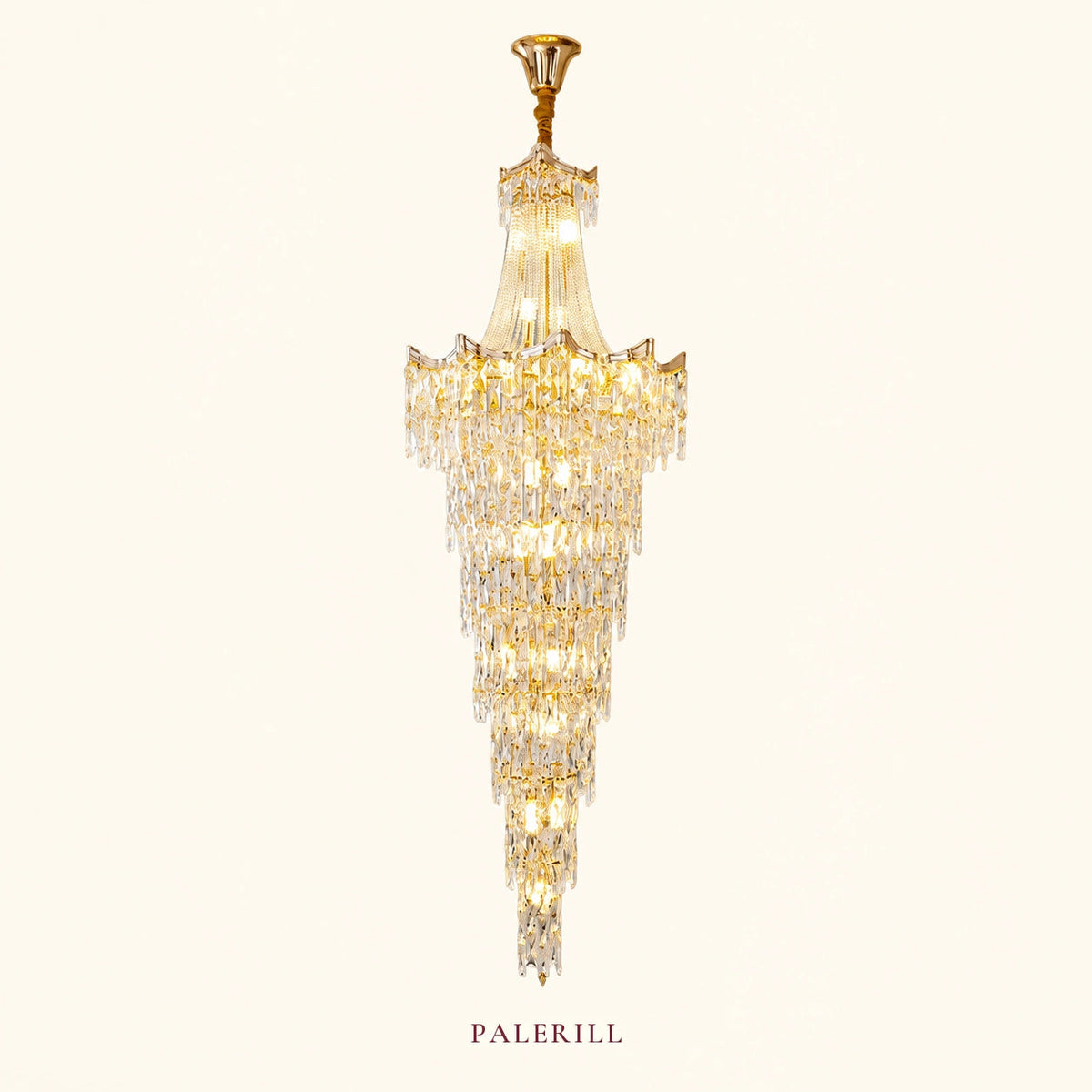
A recessed light can usually be converted, but not from the can itself. The can's junction box carries wiring, not a fixture. A chandelier needs a listed ceiling box rated for its weight, fixed to framing, plus a canopy sized to the opening. Weight above 50 lb (22.7 kg) changes the job.
What actually holds a chandelier up
Three parts carry the load, and only one of them is visible. The ceiling box is the anchor, and in US wiring it must be designed to support a luminaire of at least 50 lb (22.7 kg) unless it is listed and marked for a different figure, which is the rule in NEC 314.27(A)(2). The framing behind the plaster takes the pull, which is why a box screwed to lath or drywall alone is a failure waiting for a cleaning. The canopy is the cover that closes the gap between the fixture and the ceiling, and it decides nothing structural, though its diameter sets the smallest medallion that will look right. Of 1,381 active listings in our catalogue on 26 October 2026, 18 state a canopy dimension, so the one part a buyer can measure is also the one rarely published. Ask for it with the quote.
Why the can's own box cannot carry the fixture
A recessed housing is built to hold a lamp inside a plaster opening, and its junction box exists to make the supply connections, not to hang anything from. That box is typically a small metal enclosure clamped to the side of the housing, marked with its volume and the number of conductors it accepts, and it is not marked with a fixture-support rating. The opening itself is cut for the housing, so the aperture is fixed at the housing size, usually 4 in (10.2 cm), 5 in (12.7 cm) or 6 in (15.2 cm) across. None of that is a reason to abandon the position. It is a reason to treat the conversion as new ceiling work: the housing comes out, the opening is checked for framing, and a listed box goes in.
| What you find in the opening | What it can hold | What has to change |
|---|---|---|
| Can's side junction box, clamped to housing | Wiring connections only | Remove housing, fit a listed ceiling box |
| Metal box fixed to a joist through the plaster | Rated load printed inside the box | Keep it if the marking covers the fixture |
| Plastic box on drywall with no framing | Nothing structural | Add blocking or move to a joist |
| Fan-rated box already in place | 35 lb (15.9 kg) to 70 lb (31.8 kg), per its marking | Check the marking against the fixture |
The three routes from a can to a hanging fixture
Route one keeps the opening and fits a remodel box through it, which works when the 4 in (10.2 cm) or 6 in (15.2 cm) hole is wide enough for the box and a joist or blocking sits within reach of the box's braces. Route two abandons the opening, fixes a new box to a joist at the intended centre, and patches the old hole, which is the honest route when the can sits off centre over a table. Route three hangs the fixture from a ceiling hook on a chain, which suits a light fixture and a rented room but is not a conversion of the wiring position at all: the supply still comes from the old opening, and the chain takes the load at a hook rated for it. The three routes differ in ceiling damage, not in safety, provided each is done with a listed part.
| Route | Ceiling work | Suits | Limits |
|---|---|---|---|
| Remodel box through the existing hole | Cut back to framing, box clamps to plaster | Hole within reach of a joist, box fits the aperture | Box must be listed and marked for the load |
| New box on a joist, old hole patched | New hole, patch and paint the old one | Fixture must move to the room centre | Two ceiling repairs, one electrical job |
| Chain to a ceiling hook | One hook fixing, no box change | Light fixtures, rented rooms, no ceiling opening | Load goes to the hook, not the box |
Reading the ceiling before you buy the fixture
Two measurements decide the answer, and both are cheap to take. Joist spacing in US housing is normally 16 in (406 mm) or 24 in (610 mm) on centre, a framing convention rather than a code figure, so a fixture placed between two joists needs blocking or a box with adjustable braces. The second measurement is the weight of the finished fixture including chain, canopy and any crystal packed separately and added on site. Our catalogue states a hanging weight in a minority of listings, which is why the weight and ceiling load guide treats the number as something to request in writing. A crystal frame of 100 cm (39.4 in) diameter is not a light object, and the figure on the box marking has to cover the total, not the bare frame.
| Fixture weight | What the ceiling needs | Who decides |
|---|---|---|
| Up to 6 lb (2.7 kg) | Standard listed ceiling box | Electrician confirms the marking |
| 6 lb to 35 lb (2.7 kg to 15.9 kg) | Box marked for that load, on framing | Electrician, with the fixture weight in hand |
| 35 lb to 50 lb (15.9 kg to 22.7 kg) | Fan-rated box, marked, fixed to structure | Electrician checks the marking inside the box |
| Above 50 lb (22.7 kg) | Independent support to structure, per NEC 314.27(A)(2) | Structural fixing designed for the load |
Wiring, switching and dimming on the old circuit
The recessed light already has what a chandelier needs: a switched live, a neutral and an earth at the opening, on a circuit sized for a light. Keeping that circuit is the reason a conversion is cheaper than a new position. Three details still have to be checked. Whether the switch loop reaches the new box if the fixture moves, whether the existing dimmer is rated for the lamp the chandelier takes, and whether the fixture is wired for the supply in the building, since our fixtures are built for 100 to 240 V at 50 or 60 Hz and a US ceiling gives 120 V. A dimmer chosen for incandescent lamps will buzz or drop out with LED retrofit lamps, so the dimmer is matched to the lamp, not to the fixture.
Canopy and medallion sizing
The canopy has to cover the box opening and sit flat on the plaster, and the medallion, if there is one, has to be wider than the canopy so the canopy lands on it rather than beside it. A working convention is a medallion between 1.5 and 2 times the canopy diameter, or at least 50 mm (2 in) larger, and it is a convention rather than a rule: nothing in the electrical code governs how a decorative ring looks. Two practical checks matter more than the ratio. The medallion has to be drilled or cut for the box and the supply, and its thickness adds to the distance the canopy sits below the ceiling, which changes the drop. On a sloped ceiling the canopy also has to be a slope version, or the fixture hangs off vertical, a case covered in the sloped and vaulted ceiling guide.
| Canopy diameter | Medallion by the 1.5 to 2 times convention | Check |
|---|---|---|
| 120 mm (4.7 in) | 180 mm to 240 mm (7.1 in to 9.4 in) | Medallion clears the box screws |
| 150 mm (5.9 in) | 225 mm to 300 mm (8.9 in to 11.8 in) | Thickness added to the drop |
| 200 mm (7.9 in) | 300 mm to 400 mm (11.8 in to 15.7 in) | Ceiling rose or beam depth |
| 250 mm (9.8 in) | 375 mm to 500 mm (14.8 in to 19.7 in) | Room looks right at the height |
Cost, sequence and who signs it off
The electrical part of a conversion is small: one box, one fixture connection at 100 to 240 V, one switch check. The cost sits in the ceiling: cutting back plaster, adding blocking, patching and painting, and the last two are finishing work that shows. Sequence matters more than price. The fixture is chosen first, because its weight and canopy set the box, then the box and blocking go in, then the ceiling is made good, then the fixture hangs, and only then is the drop measured to the finished floor, to within 25 mm (1 in) of the figure on the drawing. Doing it the other way round means the drop is set by a chain cut for a ceiling that has since been patched. If the room is also being rewired, the conversion belongs in the rough-in schedule, before first fix, not after.
When converting the recessed light is not the right choice
There are five cases where the can should stay a can. The first is a ceiling with no framing within reach of the opening and no appetite for a patch, where a surface-mounted fixture on the existing box is the cheaper answer. The second is a concrete slab or a metal pan ceiling, where there is no void to work in and the box cannot be braced. The third is a listed or protected interior where cutting plaster is not permitted. The fourth is a fixture above 50 lb (22.7 kg) in a ceiling whose structure cannot be reached without opening it up, where the honest answer is a different fixture rather than a clever bracket. The fifth is a room where the can is one of a grid of six or eight downlights: pulling one out leaves a pattern with a hole in it, and the chandelier belongs on its own centre.
FAQ: recessed to chandelier conversions
Can I hang a chandelier from the recessed light's junction box? No. That box is sized and marked for wiring connections, not for supporting a fixture, and a chandelier weighs more than the box is rated to hold. The housing comes out and a listed ceiling box goes in.
Does the recessed light have to be removed? The trim and the housing do, because the housing occupies the opening the canopy has to close. The wiring stays, and in most houses so does the switch leg, which is why the job is small on the electrical side. The opposite case, where there is no box to convert and the fixture has to reach a socket instead, is set out in a chandelier on a plug instead of a ceiling box.
Do I need an electrician? For the connection and the box, in most jurisdictions yes, and always where the box has to be replaced or the circuit extended. Making good the plaster is a separate trade and is where most of the cost sits.
What if the can is not where the chandelier should be? Then the fixture moves and the old hole is patched, which is the second route above. Centring matters more over a table than in a hall, where a fixture 300 mm (11.8 in) off centre reads as a mistake. If the room is being redone anyway, this is the moment to choose the fixture against the crystal chandelier range rather than against the hole already in the ceiling.
Will the existing dimmer work? Only if it is rated for the lamp the chandelier takes. A dimmer bought for incandescent lamps usually needs replacing when the fixture arrives with LED lamps, and the replacement is chosen by lamp type and load.
Numbers and sources
| Number as written | Source | Nature |
|---|---|---|
| 1,381 active listings, 18 stating a canopy dimension | Shopify catalogue pull on 26 October 2026 (`catalog-20261026.json`), products with status active, matching the description text for "canopy" | Direct read of the store backend |
| 205 listings mentioning a chain, 0 mentioning recessed, 0 mentioning medallion | Same snapshot, substring match on the description text | Direct read plus a stated parsing rule |
| 50 lb (22.7 kg) threshold for independent support | NEC 314.27(A)(2), ceiling outlets used exclusively for lighting | Published electrical code requirement, not a measurement of your ceiling |
| 3 ft (900 mm) from the nearest wall, fan-rated box required in dwelling ceilings | NEC 314.27(A)(2), same section | Published electrical code requirement |
| 35 lb (15.9 kg) and 70 lb (31.8 kg) fan box markings | Box marking convention for ceiling-suspended fan boxes | Product marking convention |
| 16 in (406 mm) and 24 in (610 mm) joist spacing | Framing practice in US timber floors and ceilings | Trade convention, not a code figure |
| 4 in (10.2 cm), 5 in (12.7 cm), 6 in (15.2 cm) apertures | Standard recessed housing sizes sold in the US | Product convention |
| 1.5 to 2 times canopy diameter for a medallion, or 50 mm (2 in) larger | Sizing convention used by trim and medallion suppliers | Trade convention, not a standard |
| 100 to 240 V at 50 or 60 Hz | Supply our fixtures are wired for, as stated in each listing | Product specification |
| Unit conversions | 1 in = 25.4 mm, 1 lb = 0.4536 kg | Arithmetic |
Disclaimer
Every figure above carries a source and a nature. The catalogue counts are our own backend read on 26 October 2026 and describe the listings on that date. The electrical figures are quoted from published code text and from box markings, not measured in your building, and local amendments differ by jurisdiction. The medallion ratio and the joist spacing are trade conventions rather than standards. Nothing here is a structural or electrical assessment: whether a given ceiling can carry a given fixture is decided by a licensed electrician or an engineer who has seen the framing, and no fixture should be ordered against this page alone.
Related reading: an opening left by a recessed housing is usually wider than the one the new fixture needs, and canopy size against the box covers the cover per side that decides whether the rim closes the hole or leaves a ring of plaster showing.