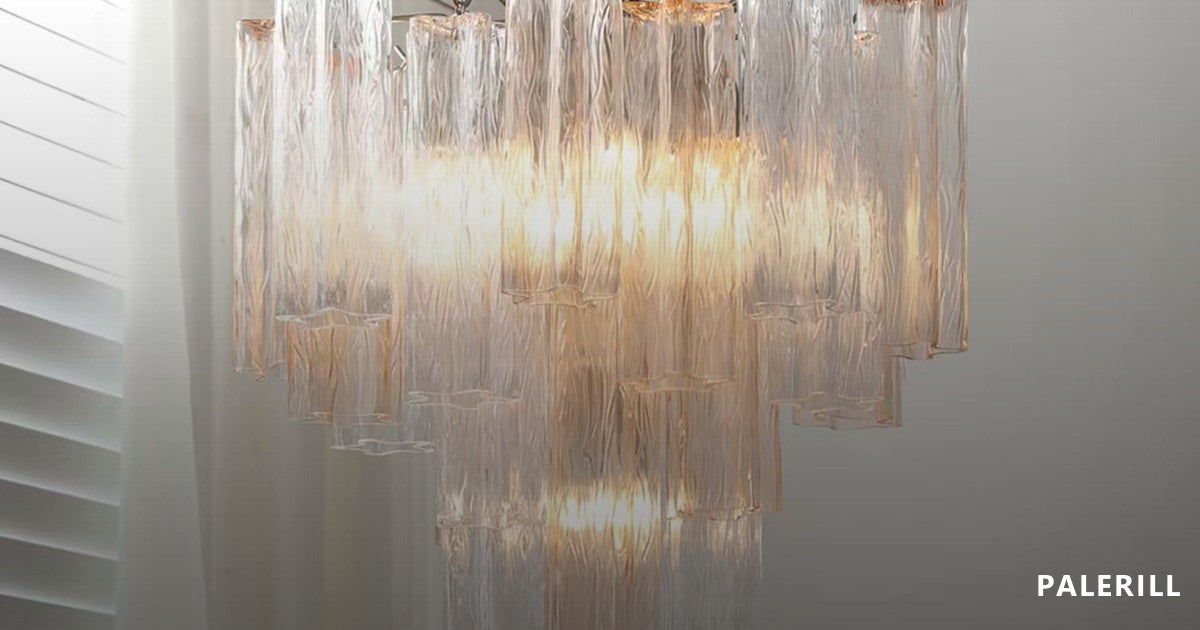
Commissioning a custom chandelier is a design process with a manufacturing tail, and the tail is where most projects lose time. This is how a commission runs when both halves are handled by the people who will actually build it.
What "custom" can mean
It helps to separate three levels of customisation, because they cost very different amounts of time:
- Adapted. An existing model with a different diameter, drop, finish or voltage. The silhouette stays; the proportions and specification move.
- Adapted composition. An existing language of elements — tiers, rings, cascades, branches — rearranged to fit a space. This is the usual route for stairwells, foyers and lobbies, and it is where the value sits for most projects.
- Bespoke. A new form designed for a specific room, developed from sketches through to a stamped drawing set.
What can be changed, and the typical ranges, is set out on the customization process page: diameter, overall height and drop, tier and ring count, cascade length, materials and metal finish, electrical specification, suspension and canopy, control, and quantity.
The process, stage by stage

1. Brief
Room type, dimensions, ceiling height and structure, desired scale, a style reference, a budget frame and a date. A section drawing or a photograph of the ceiling is worth more than a paragraph of description.
2. Concept
Sketches or a 3D view of the proposed composition with the scale indicated against your room. This is the stage to change your mind — it is cheap here and expensive later.
3. Technical drawing set
Overall dimensions, drop, canopy position, tier arrangement and component schedule, finish references, load information and packing arrangement. Issued for written approval. Production does not start until it is approved.
4. Material approval
Metal, crystal and glass samples for sign-off before production. On projects with a designer of record, this is the stage that protects the palette.
5. Production
Built to the approved set, with photographic progress and approval before packing.
6. Packing, transit and installation
Export packing for fragile heavy items, door-to-door delivery, and installation guidance for your contractor.
Custom 8 metre chandeliers and other very large work

Once a composition passes roughly 4–5 m overall height, the project stops being a light fitting and becomes a rigging exercise. The questions change: how it is transported in sections, how the sections are joined at height, how the weight is distributed across multiple fixing points rather than one, and how the electrical connections are made and tested in place. All of that belongs in the drawing set, and all of it is settled before production — not on the scaffold.
Working with a manufacturer rather than a reseller
If your specification will be questioned — by a structural engineer, a certification body, a procurement team or a client's consultant — it matters that the answers come from the workshop. Direct manufacturing access means:
- drawings and load information issued from production, not transcribed;
- samples that match what will actually ship;
- matched batches when a fixture repeats down a corridor or across suites;
- a named contact who stays with the project;
- staged delivery that can be aligned to a fit-out programme.
Trade terms and the programme are described on the designer and trade page and on projects. A worked example of the whole route is in inside a bespoke commission.
Where commissions go wrong
- Drop decided late. It is the first thing to fix and the most expensive to change.
- Ceiling not surveyed. The fixing point should be confirmed before the drawing set is approved, not after.
- Samples skipped. Metal finishes and glass colours shift under real light.
- Approval given verbally. Written approval of the drawing set is the mechanism that protects both sides.
Browse custom chandeliers for the starting points, or send a drawing and we will come back with sizes that suit the space.