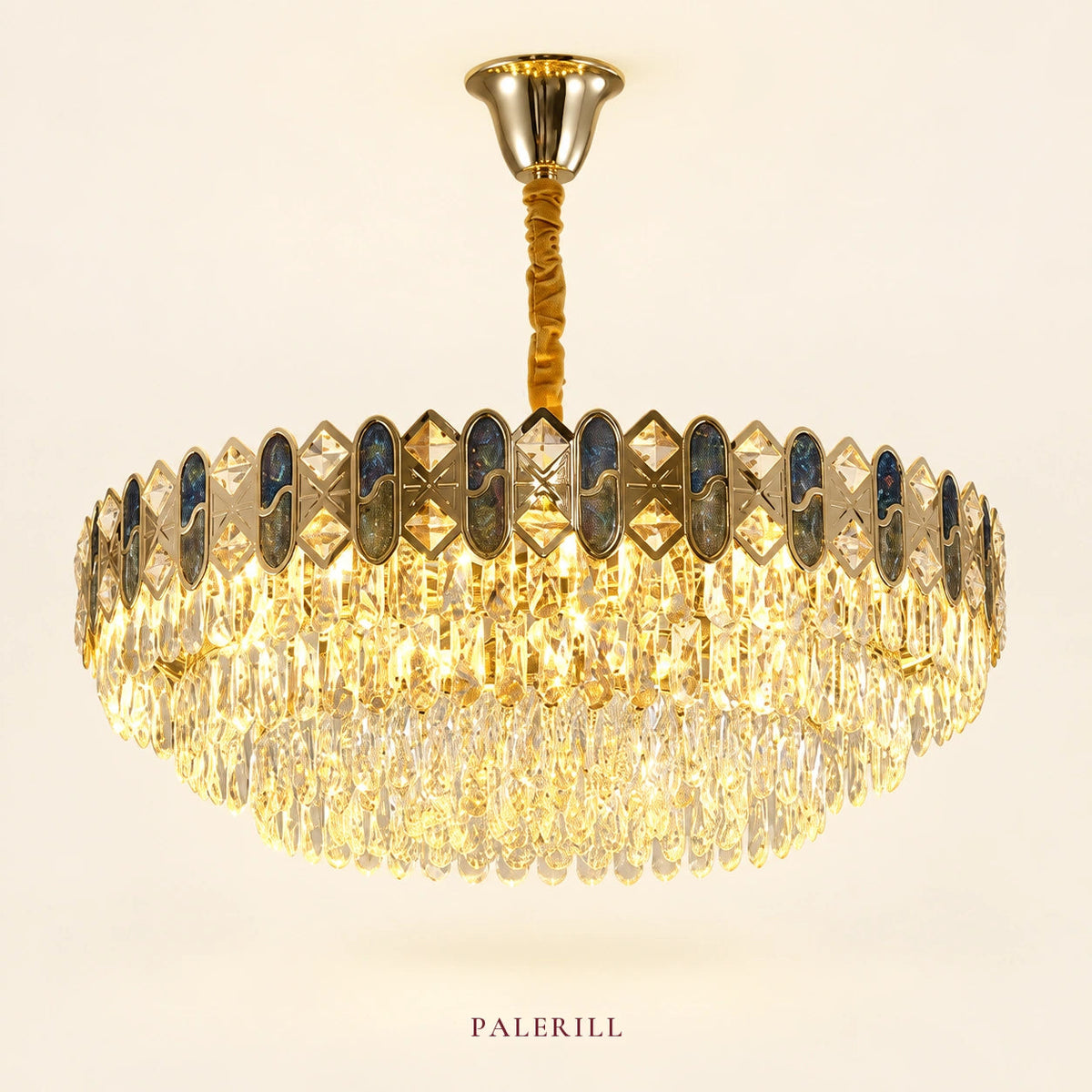
A plug-in chandelier hangs on a cord that ends in a plug, so no junction box is needed at the ceiling. It still needs three things: an anchor rated for the weight, a receptacle within cord reach, and a cord sized for the current. Eight 6 W lamps draw 0.40 A at 120 V.
What a plug-in chandelier changes, and what it does not
A plug-in chandelier changes one thing: the electrical connection moves from a splice inside a ceiling box to a plug in a receptacle. Everything above that point stays the same. The fixture still hangs from something, that something still has to be fixed to structure, and the weight still arrives at the ceiling as a downward pull. What disappears is the box, the splice and the wall switch that feeds them, and what appears in their place is a visible cord and a plug that has to reach a socket. On a 12 lb (5.4 kg) fixture with a 6 ft (1.83 m) cord, the difference is one anchor and one socket. On an 18 kg (39.7 lb) crystal body it is a different job, because a plug changes the wiring and does nothing at all for the load.
Table: what changes
| Element | Hardwired | Plug-in |
|---|---|---|
| Switching | Wall switch on the circuit | Switched socket or inline switch on the cord |
| Cord visibility | Hidden in the canopy | Visible along the ceiling and wall |
| Load path to structure | Through the box | Through the anchor, hook or swag |
| Inspection and rework | Electrician opens the box | Unplug and move |
The load side: what a crystal chandelier actually draws
The electrical load of a modern crystal chandelier is small, and it is worth calculating before choosing a cord, because the number decides whether a lamp cord is adequate. A fixture with 8 lamps at 6 W each draws 48 W, which is 0.40 A at 120 V and 0.21 A at 230 V. A 12-lamp body draws 72 W, or 0.60 A at 120 V. Even an 18-lamp composition stays under 1 A on a 120 V supply. That matters because a plug-in fixture is usually limited by the cord and the receptacle rather than by the fixture: a 15 A branch circuit is not the constraint, but a lamp cord rated at 2 A is. Always read the rating printed on the cord jacket, then keep the calculated current well below it.
Table: load
| Lamps at 6 W | Total | A at 120 V | A at 230 V |
|---|---|---|---|
| 8 | 48 W | 0.40 A | 0.21 A |
| 12 | 72 W | 0.60 A | 0.31 A |
| 18 | 108 W | 0.90 A | 0.47 A |
Two conditions sit under that table. Filament lamps change it: 8 lamps at 40 W each draw 320 W, or 2.7 A at 120 V, which is a different cord decision entirely. And a fixture with an integrated LED driver draws what the driver is rated for, not what the lamp count suggests, so the driver label is the number to use. If the fixture is being rewired rather than bought new, the lamp holders and the internal wiring also have to be rated for the current, which is one reason a conversion of an old chandelier is a job for an electrician rather than a plug and a length of cord. The guide to sockets and lumens covers the lamp side of the same calculation.
The weight side: the ceiling still carries all of it
Removing the junction box removes the part of the ceiling that was rated to hold the fixture, so the weight question becomes the first question rather than the last. A plug-in fixture hangs from a hook, a swag hook, a ceiling plate or a beam clamp, and each of those has to be fixed into framing, not into plaster or drywall alone. Our catalogue publishes a hanging weight on 10 of 1,381 listings, and those 10 run from 5 kg (11 lb) to 18 kg (39.7 lb): the top of that published range is a two-person lift and not a hook-and-hope job. Above roughly 50 lb (22.7 kg) the answer changes from hardware to structure, because a timber ceiling needs a fixing designed for the load rather than an anchor chosen from a shelf.
Table: anchor by weight, conventions
| Hanging weight | Fixing that is normally enough | What to confirm |
|---|---|---|
| 11 lb to 22 lb (5 kg to 10 kg) | Lag screw or hook into a joist, or a rated ceiling plate on two joists | Joist position and the anchor rating in writing |
| 22 lb to 50 lb (10 kg to 22.7 kg) | Rated plate spanning two joists, or a beam clamp | Plate rating at or above the fixture weight |
| Above 50 lb (22.7 kg) | Engineered fixing to structure | Structural calculation, not a hardware rating |
Those weight bands are working practice, not a code table, and the joist spacing behind them is a framing convention: 16 in (406 mm) or 24 in (610 mm) on centre in US timber ceilings. The load itself is covered from the fixture end in what a large crystal chandelier weighs, and the suspension hardware is compared in chain, rod or cable.
Cord length, conductor size and voltage drop
Cord length is the number buyers ask about last and regret first, because a plug has to reach a socket without an extension lead lying across a room. Voltage drop is what makes a long cord questionable: it rises with length, with current and with the resistance of the conductor, and it wastes a small amount of power as heat in the cord. On a 2 A load through 18 AWG copper, a 5 m (16.4 ft) run of two conductors drops about 0.42 V, which is 0.35 per cent of a 120 V supply. At 10 m (32.8 ft) the same load drops 0.84 V, or 0.70 per cent. Neither figure is dangerous; both are the reason a long run is better done in 16 AWG. The other limit is mechanical: the length that matters is the length of the route, measured with a tape rather than estimated from the floor plan.
Table: voltage drop at 2 A
| Run, out and back | 18 AWG drop | 16 AWG drop | As a share of 120 V, 18 AWG |
|---|---|---|---|
| 5 m (16.4 ft) | 0.42 V | 0.26 V | 0.35 per cent |
| 10 m (32.8 ft) | 0.84 V | 0.53 V | 0.70 per cent |
The working figures behind that table are 20.95 ohms per kilometre for 18 AWG copper and 13.2 ohms per kilometre for 16 AWG, both at 20 degrees Celsius, doubled for the return conductor. What the table does not do is rate the cord. The jacket carries the rating, printed as a type and a gauge such as SPT-2 18 AWG, and the installation has to stay inside it. A practical convention among installers is to allow 1 ft of cord for each 1 ft of travel from the fixture to the socket, plus 2 ft of slack at the plug so the cord is not under tension; that is a rule of thumb, not a standard.
Routing the cord to the receptacle
Route the cord before ordering the fixture, because the route decides whether the job is possible at all. Flexible cord may not be run through a wall, a ceiling or a floor as a substitute for fixed wiring, which is the substance of NEC 400.12, so the cord has to stay on the surface it can be seen and reached on. That leaves three routes: across the ceiling to a socket high on a wall, down the wall in a surface raceway or cord cover to a socket near the floor, or straight up to a socket in the ceiling if the room has one. Each route has a length, and the length has to be inside the cord you ordered. A route that crosses a doorway is not a route: it fails on the first evening someone carries something through it, and no cord cover makes a cord safe to step over.
Table: routes
| Route | Cord it needs | What it looks like | Constraint |
|---|---|---|---|
| Down the wall in a cord cover | Ceiling drop plus wall run plus slack | Painted cover, close to invisible | Cover has to be fixed without crushing the cord |
| Up to a ceiling socket | Short, often under 3 ft (0.91 m) | Almost nothing visible | The room has to have a ceiling socket |
| To a floor socket with an extension lead | Long | Loose lead across the floor | A trip hazard and not a permanent solution |
Two details decide whether a route is acceptable to an electrician. The socket should be on a circuit that can be switched, or the cord needs an inline switch or a smart plug, because a plug-in fixture without switching means reaching for the plug every night. And in a bathroom or any damp location the socket has to be protected by a GFCI or RCBO, which is a requirement rather than a preference; the placement rules for a fixture over a bath are covered in the guide to a chandelier over a bathtub.
Dimming a plug-in fixture without a wall dimmer
Dimming is where plug-in fixtures usually disappoint, because the wall dimmer that a hardwired chandelier would use is not in the circuit. There are three workable answers, and they are not interchangeable. The first is dimmable lamps plus a dimmable driver, controlled by an inline cord dimmer: the dimmer sits on the cord and the lamps do the work. The second is a smart plug or a plug-in dimmer module at the socket, controlled from a phone or a remote, which dims the whole load at the plug. The third is lamp-level control, where each lamp is set once and left alone. What fails is mixing a trailing-edge dimmer with a driver that expects leading-edge, which produces flicker at low output and a buzz at the fixture. Most failures appear below about 20 per cent of output, which is exactly where a dining room spends its evenings, so the fault is noticed at the worst moment.
Table: dimming options
| Method | Where the control sits | Works when | Fails when |
|---|---|---|---|
| Plug-in dimmer module | At the socket | Whole fixture is under the module rating | Load is below the module minimum |
| Smart plug, on and off only | At the socket | Only switching is wanted | Dimming is expected from it |
| Lamp-level dimming | Each lamp | Small fixture, set once | The look has to change nightly |
The compatibility point is not a preference: a dimmable LED lamp on a dimmer that does not suit its driver flickers, and the flicker is a quality problem rather than a fault. The measurable limits are PstLM at or below 1.0 and SVM at or below 0.4 under IEEE 1789-2015, and colour consistency is specified by SDCM, where a 3-step bin is the tight one. Those numbers are the ones to ask a supplier for, in writing, before a dimmable plug-in fixture is ordered for a room where the light will actually be dimmed every evening.
What our own catalogue publishes, and what it does not
Our own listings show how thin the plug-in information usually is, and it is worth stating plainly. Of 1,381 active listings on 28 October 2026, 233 state hardwired installation and 22 list a plug-in option; 51 mention a ceiling junction box and 31 mention battery operation. Only 3 publish a numeric wire length, at 9.8 ft (2.99 m) and 4.9 ft (1.49 m), while 201 publish the word adjustable and 26 publish nothing at all. Weight is published on 10 listings. Supply is better covered: 192 listings state 100V-240V, and 45 state dimmable. These are counts of a full backend pull rather than a sample, so each is a census of what a buyer can read on the page today, and the field that decides a plug-in build is the one that is almost always empty.
Table: catalogue fields
| Field | Listings stating it | Share of 1,381 |
|---|---|---|
| Plug-in option | 22 | 1.6 per cent |
| Ceiling junction box mentioned | 51 | 3.7 per cent |
| Battery operation | 31 | 2.2 per cent |
| Wire length, numeric | 3 | 0.2 per cent |
| Wire length, adjustable | 201 | 14.6 per cent |
| Hanging weight | 10 | 0.7 per cent |
| 100V-240V | 192 | 13.9 per cent |
| Dimmable | 45 | 3.3 per cent |
The honest reading of that table is that a buyer cannot tell from a listing whether a given chandelier can be supplied as a plug-in, what cord length it would arrive with, or what it weighs. The fix is a written request before the order: state the socket position, the route, the supply voltage and frequency, and ask for the cord length, the plug type, the weight and the driver rating in writing. A maker who cannot answer those four questions is telling you something too. Our fixtures are built for 100 to 240 V at 50 or 60 Hz, and the plug type follows the destination, so the answer is a build decision rather than a stock question.
When a plug-in chandelier is not the right choice
A plug-in chandelier is not the right choice when there is no socket within reach without an extension lead, which is most large rooms with the sockets at skirting level. It is not the right choice above roughly 22 kg (50 lb), where the ceiling needs an engineered fixing and the electrical question is secondary. It is not the right choice in a rental where the cord would have to cross a doorway, in a room where a visible cord on the ceiling is unacceptable to the owner, or in any commercial or hospitality space where the electrical inspector expects fixed wiring. It is not the right choice where the fixture will be dimmed every evening and the driver cannot be matched to a dimmer in writing. And it is not a shortcut for a room that simply has no ceiling outlet: the correct fix there is a new circuit and a box, which is a smaller job than it sounds and a permanent one.
FAQ: plug-in chandeliers
Can any chandelier be converted to a plug-in? Electrically, a fixture with dimmable lamps and a driver rated for the supply can be fitted with a cord set and a plug. Practically, the cord has to be joined inside the canopy or a listed box rather than taped in mid-air, and the ceiling still has to carry the weight. A fixture over 22 kg (50 lb) is a structural question first.
Does a plug-in chandelier need an electrician? In most of the US and Europe, plugging a listed fixture into an existing socket is not itself electrical work. Hanging it, joining a cord to the fixture, and deciding the anchor is work that needs someone competent, and in a rental it needs the owner's agreement.
How long can the cord be? Length is limited by voltage drop, by the cord rating and by the route. At 2 A, 18 AWG loses 0.42 V over a 5 m (16.4 ft) run and 0.84 V over 10 m (32.8 ft), so a long run is normally done in 16 AWG. The jacket rating, not the length alone, is the limit.
Will a European chandelier work in the US? Yes if it is built for the supply: our listings state 100V-240V and 50 or 60 Hz, and the plug and cord set are matched to the destination. A fixture built only for 230 V needs a driver or a transformer change, not an adapter.
Can a plug-in chandelier be dimmed with a wall dimmer? Only if the socket is on a dimmed circuit, which is unusual. Otherwise dimming happens at the cord, at a plug-in module or at the lamp. The dimmer type has to match the driver, and that has to be confirmed in writing. The crystal chandelier range quotes supply and suspension per model, and converting a recessed light to a chandelier covers the opposite move, where a box already exists.
Numbers and sources
| Number as written | Source | Nature |
|---|---|---|
| 1,381 active listings | Shopify catalogue pull on 28 October 2026 (`catalog-20261028.json`), status active | Direct read of the store backend |
| 233 hardwired, 22 plug-in, 51 junction box, 31 battery, 45 dimmable, 192 at 100V-240V | Same snapshot, case-insensitive substring match on the plain-text description | First-party, recomputed mechanically |
| 3 numeric wire lengths at 9.8 ft and 4.9 ft, 201 adjustable, 26 not stated | Same snapshot, value parsed from the wire-length field | First-party, recomputed mechanically |
| 10 listings with a hanging weight, 5 kg to 18 kg | Same snapshot, weight field where present | First-party, recomputed mechanically |
| 16.9, 1.6, 3.7, 2.2, 0.2, 14.6, 0.7, 13.9 and 3.3 per cent | Arithmetic on the counts above, against 1,381 | Arithmetic |
| 4 to 18 lamps at 6 W, 0.10 A to 0.90 A | Arithmetic: watts divided by volts, at 120 V and 230 V | Arithmetic on a stated lamp load |
| 0.17 V, 0.42 V, 0.84 V drop at 2 A; 0.14 to 0.70 per cent | 18 AWG copper at 20.95 ohms per kilometre, doubled for the return conductor, at 20 degrees Celsius | Arithmetic on published conductor resistance |
| 0.11 V, 0.26 V, 0.53 V at 16 AWG | Same method at 13.2 ohms per kilometre | Arithmetic |
| 5 kg to 18 kg published weights, 18 kg = 39.7 lb, 50 lb = 22.7 kg | Unit conversion at 1 kg = 2.2046 lb | Arithmetic |
| 9.8 ft = 2.99 m, 4.9 ft = 1.49 m, 5 m = 16.4 ft | Unit conversion at 1 ft = 0.3048 m | Arithmetic |
| Cord may not be run through walls, ceilings or floors | NEC 400.12, uses not permitted for flexible cords | Published code text, US; local amendments differ |
| GFCI protection in damp locations | NEC 210.8, ground-fault protection | Published code text, US |
| 50 lb (22.7 kg) as the point where a ceiling outlet needs independent support | NEC 314.27(A)(2) | Published code text, US |
| PstLM at or below 1.0, SVM at or below 0.4 | IEEE 1789-2015, recommended practice for modulating light | Published standard |
| SDCM 3-step bin | ANSI C78.377 colour consistency practice | Published standard |
| 18 AWG at 20.95 ohms per kilometre, 16 AWG at 13.2 ohms per kilometre | Standard copper conductor resistance tables at 20 degrees Celsius | Published table value |
| Weight bands by anchor type, 1 ft of cord per 1 ft of travel plus 2 ft slack | Working practice among installers | Trade convention, not a standard |
| 16 in or 24 in joist spacing | Framing practice in US timber ceilings | Trade convention, not a code figure |
Disclaimer
The catalogue counts describe the listings as they stood on 28 October 2026 and will drift as the range changes. The electrical figures are arithmetic on a stated lamp load and on published conductor resistance, not a measurement of any particular fixture; the code references are quoted from published US text and local amendments differ by jurisdiction. The anchor bands, the 1 ft per 1 ft cord allowance and the joist spacing are working conventions rather than standards, and nothing in this page is a structural or electrical assessment. Whether a given ceiling can carry a given fixture, and whether a given cord and plug arrangement is acceptable in a given room, is decided by a licensed electrician or an engineer who has seen the framing, the hardware and the socket. Do not order a fixture against this page alone.