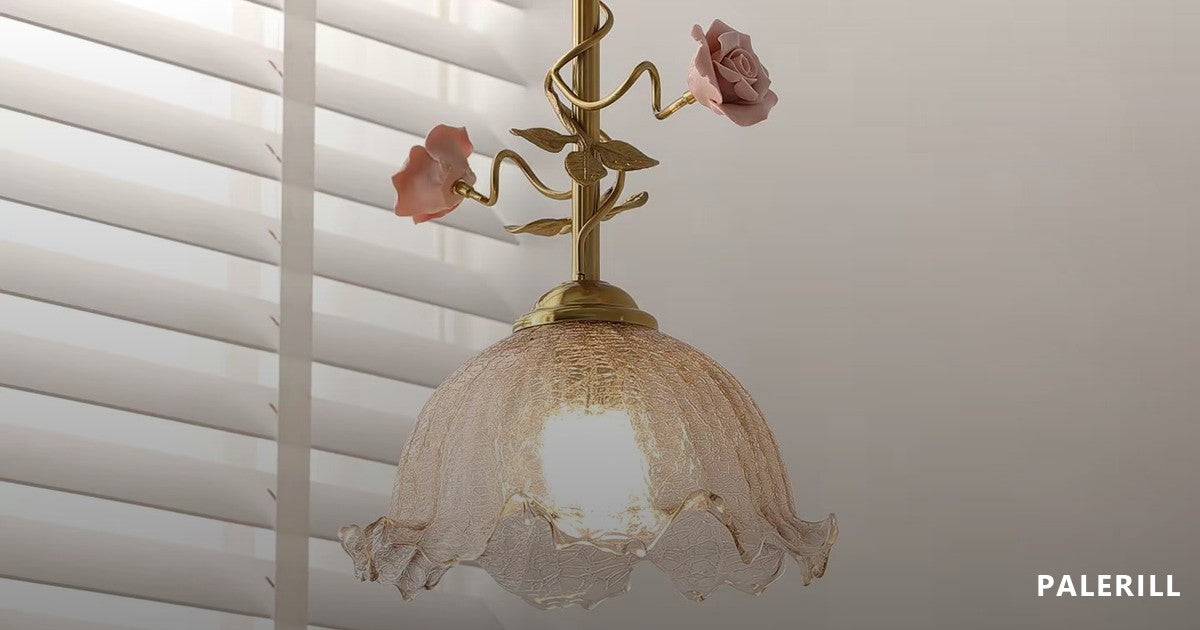
A chandelier can hang in a bathroom, and not over the bathtub unless it clears the code zone: 900 mm (3 ft) horizontally and 2.5 m (8 ft) above the rim, under NEC 410.10(D). On a normal ceiling that zone reaches past the ceiling line, so the fixture belongs over the room centre.
The 900 mm and 2.5 m rectangle that decides it
The rule that decides a bathroom chandelier is a rectangle rather than a taste. Section 410.10(D) of the National Electrical Code prohibits a luminaire in a damp or wet location inside a zone measured 900 mm (3 ft) horizontally from the top of a bathtub rim or a shower stall threshold, and 2.5 m (8 ft) vertically above that same line. A bathroom is a damp location in North American practice, so the fixture has to be listed for damp locations as well as sit outside the zone. Two consequences follow from the wording. The measurement starts at the rim of the tub and not at the floor, and it applies to any part of the luminaire, so a crystal tier hanging below the body is inside the rectangle for the purpose of the rule.
| Where the fixture sits | North America | Europe and the UK | Minimum rating |
|---|---|---|---|
| Inside the tub or the shower tray | Prohibited | Zone 0 | IPX7 |
| Above the tub, within 900 mm (3 ft) of the rim | Prohibited | Zone 1 and zone 2 | IPX4 |
| Beyond 900 mm (3 ft) of the rim, same room | Permitted, damp-listed | Outside the zones | Ordinary fixture |
| In a steam room or over a wet-room floor drain | Assessed as a wet location | Zone 1 throughout | IPX5 or better |
What the rectangle does to a normal ceiling
Work the geometry once and the practical answer appears, because the vertical limit is the part people misread. Take a tub rim at 570 mm (22.4 in) above the floor, which is a common rim height, and add the 2.5 m (8 ft) vertical limit: the top of the prohibited zone sits at 3.07 m (10 ft 1 in) above the floor. An 8 ft ceiling is at 2.44 m, so the zone passes through the ceiling with 630 mm (24.8 in) to spare. A 10 ft ceiling at 3.05 m still leaves the zone 20 mm above the ceiling, which is smaller than any joist deflection worth arguing about. The vertical limit is therefore not the escape route; the 900 mm horizontal clearance is, and it is the only one a residential room can satisfy. Measure the rim at its highest point, because a tub deck that steps up adds height to the whole measurement.
| Ceiling height | Top of the 8 ft zone above the rim | Zone above the ceiling line |
|---|---|---|
| 2.44 m (8 ft) | 3.07 m (10 ft 1 in) | 630 mm (24.8 in) |
| 2.74 m (9 ft) | 3.07 m (10 ft 1 in) | 330 mm (13.0 in) |
| 3.05 m (10 ft) | 3.07 m (10 ft 1 in) | 20 mm (0.8 in) |
In a tub alcove 1.7 m (5 ft 7 in) long, the centre of the tub is 850 mm from each end wall, which is already 50 mm inside the 900 mm clearance. A fixture over the middle of that alcove fails the rule at every ceiling height, and the same fixture moved 1 m (3 ft 3 in) towards the centre of the room passes it. That is the whole design decision: the chandelier goes over the open floor, and the tub keeps a ceiling light, a sconce or nothing.
What a damp location changes about the fixture
A damp rating is a property of the enclosure rather than of the crystal, and it shows up in four places on a real fixture: a canopy that closes against the ceiling on a gasket, lamp holders with a seal at the base, a wiring chamber that is not open to the room air, and a finish system that survives condensation. The IP code is the shorthand for the enclosure, and its second digit is the one that matters here, because the first digit is about dust and the second is about water. A fixture marked IPX4 keeps out splashing water from any direction, IPX5 adds jets from a 6.3 mm nozzle at 12.5 litres per minute, and IPX7 covers temporary immersion. In Europe the same code is written into the bathroom zones of HD 60364-7-701, which asks for IPX4 in the volumes above and beside the tub.
| Second digit | What it withstands | Where it is the minimum in a bathroom |
|---|---|---|
| 4 | Splashing water from any direction | The volume above the tub, in European practice |
| 5 | Water jets, 6.3 mm nozzle, 12.5 litres per minute | A wet room, a steam shower, a pool room |
| 7 | Temporary immersion, 1 m for 30 minutes | Inside the tub volume, which we would not fill with a fixture |
In North America the equivalent evidence is a listing mark rather than a number, and the words to look for on the label are that the luminaire is suitable for damp locations. Ask for a photograph of the label. A supplier who answers a damp-location question with the word outdoor has not answered it.
How high the fixture hangs
Height in a bathroom is a clearance question before it is a proportion question, because people stand under this fixture rather than sitting beside it. The working convention is 2.1 m (6 ft 11 in) from the finished floor to the lowest crystal, which keeps a head and a raised arm clear, and it is a convention drawn from stairwell and corridor practice rather than a code figure. On a 2.44 m (8 ft) ceiling that leaves 340 mm (13.4 in) of drop below the ceiling, which suits a semi-flush body and rules out a long-tiered pendant. On a 3.05 m (10 ft) ceiling the same convention allows a 950 mm (37.4 in) drop, which is where a pendant starts to look proportionate in a large primary bath. Measure the ceiling at the fixing point rather than in the middle of the room, because a coffered or vaulted bathroom varies by more than the drop margin.
What fails first in a wet room
Moisture attacks three parts of a crystal chandelier in a fixed order: the finish on the frame, then the joints where crystal meets metal, then the crystal itself, and the order matters because the first two are cheap to prevent and the third is not. Lacquer bloom, a white haze on a brass or bronze frame, appears where relative humidity sits above 60 percent for long periods, and it is a surface effect that a polish removes rather than corrosion. Water spots on crystal come from the minerals left when droplets dry, which is why a bathroom with hard water marks a fixture faster than a hallway with the same dust load. Inspect the canopy and the frame every six months in a bathroom, against every twelve months in a dry room, and wipe the lower tiers after any steamy week rather than waiting for the annual clean.
Ventilation is the part that keeps it dry
An extract fan is the cheapest way to protect a fixture, and its size is specified rather than guessed. ASHRAE 62.2 sets bathroom exhaust at 50 cfm (85 cubic metres per hour) intermittent or 20 cfm (34 cubic metres per hour) continuous, and a fan that runs only while the shower is on does not meet the continuous figure for the hours the room stays humid afterwards. The target to hold is relative humidity below 60 percent, which is the threshold where bloom and mould both slow down, and a hygrometer costs less than a service call. Run the fan for 20 minutes after a shower rather than 5, keep the door open afterwards, and a crystal fixture in the room will hold its finish through a decade of use.
Sizing the fixture for the room
Size follows the room rather than the tub, since the fixture is now hanging over open floor. The industry convention is that the diameter in inches equals the sum of the room length and width in feet, which is a convention and not a standard, and it lands sensibly in bathrooms of normal proportion. Check it against the walkway as well: the fixture should leave 900 mm (3 ft) of clear floor on the side people pass, so a narrow powder room takes a smaller body than the convention suggests. Where the ceiling is above 3 m (9 ft 10 in), add 25 mm (1 in) to the diameter for every 300 mm (1 ft) of height above 2.7 m (8 ft 10 in), which is the same allowance used for tall rooms elsewhere on this site.
| Bathroom | Floor area | Diameter by convention | Note |
|---|---|---|---|
| Powder room, 1.7 by 2.4 m | 4.1 sq m (44 sq ft) | 330 mm (13 in) | Single tier, semi-flush |
| Family bath, 2.4 by 3.0 m | 7.2 sq m (78 sq ft) | 457 mm (18 in) | Check the door swing |
| Primary bath, 3.0 by 4.0 m | 12 sq m (129 sq ft) | 584 mm (23 in) | Two tiers read better at 3 m |
What our catalogue states, and the line that is missing
We read our own catalogue on 19 October 2026, all 1,381 active products, and counted by product rather than by mention, so a model that repeats the same label twice counts once. Forty-five products name a bathroom anywhere in the description, and none of them is a chandelier: they are wall lights and small pendants, which reflects how the range was built rather than what can be produced. An IP code appears on 131 products, the lowest code anywhere in the catalogue is IP44, and 2 products state IP44 itself, because the codes are published on outdoor models far more often than on indoor ones. No product states a damp-location listing. The honest reading is that a chandelier for a bathroom is a specification conversation rather than a catalogue choice, and the questions in the table are the ones to put to us in writing.
| Line | Products, 19 October 2026 | What it tells you |
|---|---|---|
| Products naming a bathroom | 45 | Wall and vanity fixtures, no chandeliers |
| Any IP code stated | 131 | Every one of them IP44 or better |
| Products stating IP44 itself | 2 | The code a bathroom needs, and it is rarely the one written |
| Damp-location listing stated | 0 | The line to ask about directly |
When a chandelier in a bathroom is not the right choice
There are rooms where the answer is no, and they are worth naming before a drawing is made. A steam shower that runs daily puts the fixture in a wet location where a crystal body collects condensate on every surface, and the finish will not hold however the enclosure is sealed. A wet room with a floor drain and no enclosure has no reliable boundary, so the whole ceiling is in play. A bathroom whose only free ceiling is inside 900 mm (3 ft) of the rim cannot take a chandelier under the rule, and that includes most tub alcoves. A room with a ceiling below 2.2 m (7 ft 3 in) leaves no drop for a pendant, and a semi-flush body at that height is a light rather than a feature. Where the household is buying for resale, a damp-rated fixture with a paper trail is worth more than a larger one without.
Where the fixture is being chosen for a room that is dry, how to clean and maintain a crystal chandelier sets the interval that this page shortens for a bathroom. Where the ceiling has to carry the weight before it carries the finish, chandelier weight and ceiling load covers the fixing. Where the circuit is being planned with the electrician, lighting schedule and rough-in covers the switch and the dimmer. The damp-rated wall fixtures that already name a bathroom are in our wall light collection, and the indoor bodies that can be re-specified for a bathroom are in our chandelier collection.
Numbers and sources
Every figure here was either calculated from the geometry above, read from the code text, or counted in our own export, and the table below says which. Two of them deserve a caution. The zone in NEC 410.10(D) has been stable in recent editions and is still interpreted by the authority having jurisdiction, so a plan that depends on 20 mm of clearance should be shown to that authority rather than argued from this page. The European zone boundaries in HD 60364-7-701 have changed between editions, which is why the electrical designer's drawing governs rather than any number quoted here. The convention figures are labelled as conventions because a convention can be departed from with a reason, and a standard cannot. Nothing on this page is a substitute for a licensed electrician's assessment of a specific room, and nothing here promises that a fixture will pass inspection.
| Figure | Value | Source | Nature |
|---|---|---|---|
| Prohibited zone, North America | 900 mm (3 ft) horizontal, 2.5 m (8 ft) vertical from the rim | NEC 410.10(D) | Standard, interpreted locally |
| Damp location, definition | Protected from weather, subject to moderate moisture | NEC Article 100 | Standard |
| Bathroom receptacle protection | GFCI required for receptacle outlets | NEC 210.8 | Standard, outlets only |
| European bathroom zones | Zone 0, 1 and 2 with IPX4 above and beside the tub | HD 60364-7-701 | Standard, edition dependent |
| IP second digit | 4 splash, 5 jets at 12.5 litres per minute, 7 immersion | IEC 60529 | Standard |
| Tub rim height | 570 mm (22.4 in) | Common rim height | Convention, measured on site |
| Top of the zone | 3.07 m (10 ft 1 in) above the floor | Arithmetic, rim plus 2.5 m | Calculated, not measured |
| Floor clearance | 2.1 m (6 ft 11 in) to the lowest crystal | Stairwell and corridor practice | Convention, not a standard |
| Bathroom exhaust | 50 cfm (85 cubic metres per hour) intermittent, 20 cfm (34) continuous | ASHRAE 62.2 | Standard |
| Relative humidity target | Below 60 percent | Finish and mould threshold | Convention, not a standard |
| Fixture diameter | Room length plus width in feet, read as inches | Industry convention | Convention, not a standard |
| Catalogue size | 1,381 active products | Shopify export, 19 October 2026 | First party, recomputed |
| Products naming a bathroom | 45, none a chandelier | Same export, description text | First party, recomputed |
| Products stating an IP code | 131, lowest code IP44, 2 stating IP44 itself | Same export, description text | First party, recomputed |
| Damp-location listing | 0 products | Same export, description text | First party, recomputed |
Related reading: the location marking that decides whether a fixture may hang in a wet room is the same marking that decides a porch, and damp and wet location ratings for a porch chandelier sets out what the label has to say and what an ingress figure does not prove.