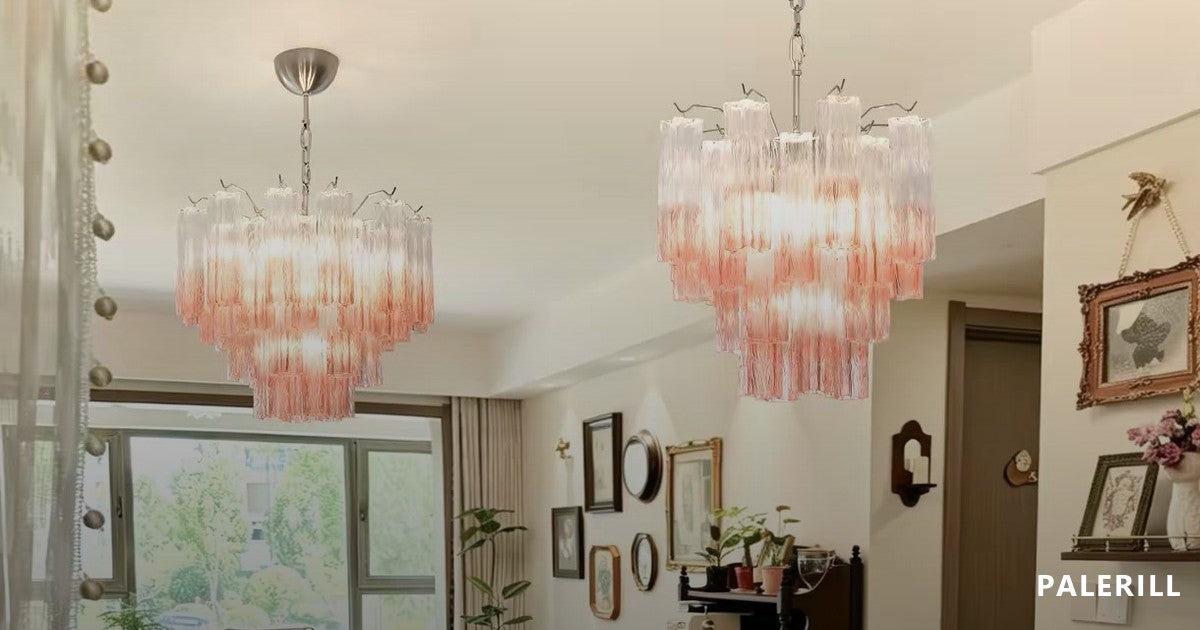
A chandelier listing carries three heights that are not interchangeable. Fixture height measures the body alone. Total hanging height adds the suspension and canopy above it. Adjustable drop is the range over which that suspension shortens or lengthens on site. Read the wrong figure and the light arrives at the wrong height.
What fixture height actually measures
Fixture height is the vertical measurement of the light body on its own, taken from the lowest crystal or shade to the top of the frame with no suspension attached. It is the figure that tells you how much vertical space the fitting occupies and how deep the body reads from the room, and it does not change with the way the light is hung. Published values need the unit read with the number, because the same body is written as H 1.3 m, H 130 cm or H 1300 mm depending on the listing. On a crystal chandelier the body height also drives mass, since frame, arms and crystal scale together, so it is the first figure to check against the ceiling load before anything else. What fixture height never tells you is how low the light will hang in your room.
What total hanging height adds to it
Total hanging height is the fixture height plus the suspension plus the canopy, measured from the ceiling surface down to the lowest point of the crystal. Some listings call it overall drop, and it is the only figure that decides the clearance you keep under the light. The arithmetic is a single subtraction: take the ceiling height at the fixing point, subtract the clearance you want to keep under the lowest crystal, and the remainder is the total hanging height the room allows. In a 6.1 m (20 ft) foyer keeping 2.1 m (6 ft 11 in) of walking clearance leaves 4 m (13 ft 1 in) of total hanging height. If the body is 1.6 m (63 in) deep, the suspension has to supply the remaining 2.4 m (94.5 in), and the stairwell chandelier drop and clearance guide works through the same sum in a double-height void.
Where adjustable drop fits in
Adjustable drop is the working range of the suspension, not a separate height. A chain fixture has removable links and a wire fixture has a cable that is trimmed at installation How each of the three is adjusted, and where the load actually goes, is set out in chain, rod or cable suspension., and in both cases the canopy slides up to close the gap against the plaster. Of the 1,381 products live in our catalogue on 15 October 2026, 201 state their wire length as adjustable, and 204 are built for chain or wire suspension. Adjustability is never unlimited. The shortest setting is the body plus the smallest link stack the canopy will cover, and the longest is the supplier length, so a fixture quoted at 3 m (9.8 ft) of wire cannot be set at 40 cm (15.7 in) without rebuilding the canopy. Rod suspension is different again: a rod is cut to a fixed length at the factory, so its drop is decided before production rather than on site.
How to measure a room for the drop you need
Work from the floor upwards, because the floor is the reference that never moves. Start with the finished floor to ceiling height directly above the fixing point, not the room average and not the ridge, then decide the clearance to keep under the lowest crystal. The walking figure designers use is 2.1 m (6 ft 11 in), and above a dining table the trade convention is 30 in to 36 in (762 mm to 914 mm) measured from the tabletop rather than the floor. Both are conventions rather than standards, so treat them as a starting point and not a code. Subtract the clearance from the ceiling height and the result is your total hanging height budget. Take the body height off that and what is left is the suspension length to specify, which is the one number worth sending us in writing before an order is placed. In a bedroom the same subtraction runs from the bed rather than from the walkway, and the figures are worked through in bedroom chandelier size and height. Where the ceiling already carries a fan, the subtraction starts from a known height rather than a guess, because a fan is set 7 ft (213 cm) above the floor and the chandelier inherits the same walking clearance; the swap and the diameter arithmetic behind it are set out in replacing a ceiling fan with a chandelier.
Unit mixing is the usual source of a wrong drop, so quote the ceiling height and the body height in the same unit before subtracting one from the other. Our chandelier sizes in inches and centimetres guide carries the conversion table used when a room is measured in feet and inches but the fixture is built in millimetres, and chandeliers for 20 and 25 foot ceilings works the same subtraction through a taller void.
| Measurement | Where to take it | What it decides |
|---|---|---|
| Finished floor to ceiling | Directly above the fixing point, not the room average | Total hanging height budget |
| Clearance under the lowest crystal | Floor to the bottom of the fixture | Whether the light fouls the walking line |
| Tabletop to fixture bottom | Table surface to lowest point, where a table sits under the light | Whether the light sits too low over a table |
| Fixture body height | Lowest crystal to top of frame | How much of the budget the body consumes |
| Suspension length | Canopy to the top of the body | The figure we build the drop to |
How our listings publish the three numbers
The three heights sit in three different places on a product page, which is why they get confused. The body height is normally written into the variant name beside the diameter, in a form such as diameter 80 cm (31.5 in) with height 1.3 m (51.2 in). Where the body is built in tiers, the tier count and the spacing between tiers are what make up that height. The suspension appears in the specification table under the wire length or height and drop range row, and the mounting format appears under the hanging method row. Across our catalogue 240 products state a fixture height in a variant name, 382 state a diameter with an explicit prefix, and 188 state both. Two hundred and ten of the listings that state a height offer more than one selectable value, so the drop on those is chosen at the point of order rather than at installation. When a row is missing, the field is unpublished for that product rather than refused.
| Where it appears | What it states | Unit form used |
|---|---|---|
| Variant name | Body height, usually beside the diameter | mm, cm or m |
| Wire length row | Whether the suspension adjusts, and any fixed supplier length | Adjustable or a stated length |
| Hanging method row | Chain, wire, flush ceiling mount or wall mount | Text |
| Height and drop range row | Published body height and any drop range | mm, cm or m |
| Size range row | The full width and height span offered | cm and inches |
When a long-drop chandelier is not the right choice
A long-drop chandelier is the wrong purchase for a standard 2.4 m (7 ft 10 in) ceiling, where a semi-flush or flush light does the same job with none of the wasted suspension. It is also the wrong purchase when the drop you need is shorter than the body plus the smallest covered link stack, because no amount of adjustment closes that gap. Stop and ask before ordering whenever the body height is not published at all, since the drop cannot be calculated without it. In our catalogue 240 of 1,381 products state a height in a variant name, which leaves the large majority without a published body height, and for those the figure has to come from us in writing. Do not plan to shorten a rod fixture on site, and do not rely on swagging a chain across a ceiling to fake extra height. Where the void is tall but narrow, a foyer chandelier in a longer, slimmer format usually reads better than a wide one hung low. The ceiling-height arithmetic that decides which formats clear a low room is set out in chandelier for a low ceiling.
Numbers and sources
Every catalogue figure here was recomputed from our own Shopify export of 15 October 2026, which held 1,381 live products and 9,851 variants. A stated body height means a value written in a variant name after an H or height prefix, converted to centimetres, and falling between 20 cm and 1,000 cm; that window keeps data-entry errors out of the distribution, and 240 products carry at least one such value. The other variant-name counts are 382 products stating a diameter with an explicit prefix, 188 stating both, and 210 of the 240 offering more than one selectable stated height. The suspension figures are 201 products publishing an adjustable wire length and 204 built for chain or wire suspension. Across 1,198 stated values the median is 100 cm (39.4 in) and the ninetieth percentile is 260 cm (102.4 in), with 268 at or above 200 cm and 78 at or above 300 cm.
| Figure | Value | Source | Nature |
|---|---|---|---|
| Live products | 1,381 products / 9,851 variants | Shopify catalogue export, 15 October 2026 | First-party, recomputed |
| Products stating a fixture height | 240 of 1,381 products | Same export, variant names | First-party, recomputed |
| Products stating a diameter | 382 of 1,381 products | Same export, variant names | First-party, recomputed |
| Products stating both | 188 of 1,381 products | Same export, variant names | First-party, recomputed |
| Products with selectable heights | 210 of the 240 products | Same export, variant names | First-party, recomputed |
| Adjustable wire length | 201 of 1,381 products | Same export, specification tables | First-party, recomputed |
| Chain or wire suspension | 204 of 1,381 products | Same export, specification tables | First-party, recomputed |
| Stated body heights | 1,198 values, median 100 cm, p90 260 cm | Same export, variant names | First-party, recomputed |
| Walking clearance | 2.1 m (6 ft 11 in) under the lowest point | Trade convention | Not a standard, not measured here |
| Tabletop clearance | 30 in to 36 in (762 mm to 914 mm) | Trade convention | Not a standard, not measured here |
| Unit conversion | 25.4 mm per inch | Arithmetic | Definitional |
How a manufacturer records a height is a naming convention rather than a safety rule. Whether a ceiling can carry the fixture, and how the supply is wired, are questions for a qualified electrician working on site; the clearances quoted above are design guidance only.