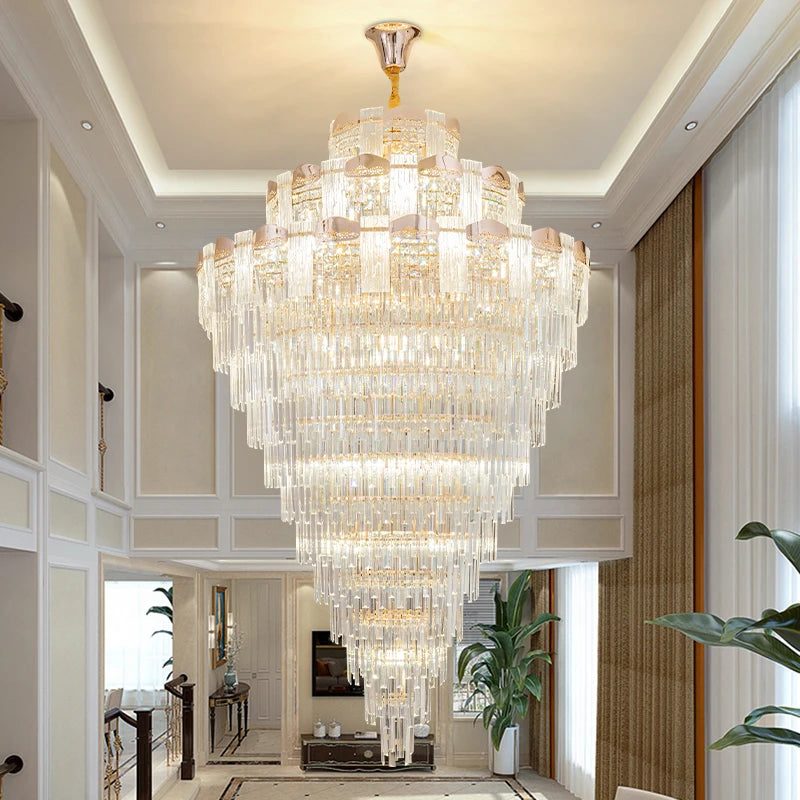
A chandelier can hang on a covered porch, but only one thing makes it legal and durable: a fixture listed and marked for a damp location. Under an open pergola, or anywhere wind-driven rain reaches the fixture, it must be marked for a wet location instead. The label decides, not the word outdoor.
What damp and wet location actually mean
The two words are defined by exposure, not by whether a space feels like the outdoors. NEC Article 100 defines a damp location as one protected from weather and not subject to saturation with water, but subject to moderate degrees of moisture, and names roofed open porches among its examples. A wet location is defined as unprotected and exposed to weather, or subject to saturation, or installed underground or in concrete in contact with the earth. The practical test is whether precipitation can reach the fixture at all, and it is applied to the fixture rather than to the room. A roof or canopy that keeps rain off the housing keeps a porch in the damp category. A shallow eave that admits wind-driven rain does not, because the code asks what reaches the fixture, not what the drawing calls the space.
| Location | Article 100 in plain terms | Porch case | Marking the fixture needs |
|---|---|---|---|
| Dry | Not normally subject to dampness | Enclosed, conditioned sunroom | None required |
| Damp | Protected from weather, moderate moisture only | Roofed open porch, covered patio, soffit | Suitable for damp locations |
| Wet | Unprotected, exposed to weather, or saturated | Open pergola, unroofed deck, poolside, below grade | Suitable for wet locations |
The marking on the label is the only thing that counts
A fixture sold as outdoor lighting has not thereby been rated for a porch. The rating is a marking applied under a listing to UL 1598, the standard for luminaires, and it reads either suitable for damp locations or suitable for wet locations. NEC 410.10(A) makes the rule one-directional: every luminaire in a wet location must be marked for wet locations, while a luminaire in a damp location may carry either marking. IRC 2024 Section E4004.1 repeats the requirement for one and two family dwellings, so an inspector will look for the same words. A damp-marked fixture in a wet location is a violation however long it has survived there. Ask for the exact wording on the label, in writing, before the order is placed, because it is the only part of the specification an inspector can verify on site.
What an IP code does and does not prove
An IP code describes ingress protection only, and it is set out in IEC 60529. The first digit covers solids on a scale from 0 to 6, where 4 means protected against objects of 1 mm and above and 6 means dust-tight. The second digit covers water on a scale from 0 to 8, where 4 means splashing water and 5 means water jets. The test behind the second digit is specific: IPX5 plays a 6.3 mm nozzle at 12.5 litres per minute and 30 kPa from about 3 m for at least 3 minutes. The code says nothing about salt, ultraviolet light, thermal cycling or corrosion, and nothing about whether a nationally recognised testing laboratory has listed the fixture at all. A fixture can carry the highest ingress digits and still be unlisted, which is why the marking and the code answer different questions.
| Digits, solids then water | What was tested | What it does not cover |
|---|---|---|
| 4 / 4 | 1 mm solids, splashing water from any direction | Rain driven at pressure, salt, UV |
| 6 / 5 | Dust-tight, 6.3 mm jet at 12.5 litres per minute | Immersion, salt fog, corrosion of fixings |
| 6 / 6 | Dust-tight, 12.5 mm jet at 100 litres per minute | Immersion, salt fog, the listing itself |
What our own outdoor collection states
This is the part a supplier usually leaves out, so here it is in full. On 2 November 2026 we read all 1,829 active listings in our own admin and searched the title and description text of each one. The outdoor lighting collection holds 345 products. Of those 345, 125 state an ingress figure of the IP kind somewhere in the text: 119 write a 6 for solids with a 5 for water jets, and 1 writes 4 with 4. A water-resistance adjective, rather than a code, appears in 238 of the 345. The count that matters for a porch is zero: no listing of the 345 states a damp location or a wet location marking, and across the whole catalogue of 1,829 the same count is also zero. That is not a boast. It is the question to put to us, and to any supplier, before a porch fixture is specified.
| What the listing text states | Outdoor collection (345) | Whole catalogue (1,829) |
|---|---|---|
| Any IP figure | 125 (36.2 percent) | 131 (7.2 percent) |
| The 6 / 5 pair | 119 (34.5 percent) | 120 (6.6 percent) |
| The 4 / 4 pair | 1 (0.3 percent) | 2 (0.1 percent) |
| A water-resistance adjective | 238 (69.0 percent) | 247 (13.5 percent) |
| A damp or wet location marking | 0 (0.0 percent) | 0 (0.0 percent) |
| UL or ETL named | 0 (0.0 percent) | 988 (54.0 percent) |
The counts are a text search of stored descriptions, not a reading of the labels on crates, and the difference matters: a marking can exist on a product label while the description stays silent. It also runs the other way, and that is the risk. An adjective is marketing rather than measurement: IEC 60529 grades water by digit, so a listing that reaches for a word instead of a code has told a buyer nothing that can be checked.
Materials that survive a porch
Moisture rarely destroys a chandelier by shorting it. It destroys the parts around the light: plated steel arms that blister, mild steel chain that rusts from the inside of each link, and lacquered brass that goes patchy where the film breaks. Crystal and glass are indifferent to water, but a porch exposes them to dust, pollen and detergent residue that etch a matte film over a season. The alloys decide the outcome. Type 304 stainless contains roughly 18 percent chromium and 8 percent nickel; type 316 adds 2 to 3 percent molybdenum, which is what resists chlorides in coastal air. Brass is durable but dezincifies in salt air, turning reddish and brittle. Powder coat protects aluminium until it chips, and then the exposed edge becomes the failure point, which is why the film thickness and the pretreatment matter as much as the alloy beneath it.
| Material | Behaviour on a porch | What to specify instead |
|---|---|---|
| Plated steel | Blisters at edges, rust bleeds onto plaster | Powder-coated aluminium or brass |
| Mild steel chain | Rusts inside each link, stains the ceiling | 316 stainless chain or rigid rod |
| Lacquered brass | Film breaks at touch points, patchy tarnish | Unlacquered brass, waxed annually |
| Type 304 stainless | Pitting in salt air within a season or two | Type 316 where chlorides are present |
| Crystal and glass | Water is harmless, films and etching are not | Removable dressings, annual wash |
Fixing, wind and drop
A porch is a place where a fixture moves, and the fixing has to allow for that. In US wiring, a ceiling box must be able to support a luminaire of at least 50 lb (22.7 kg) unless it is listed and marked for a different figure, under NEC 314.27(A)(2); the same section requires independent support for a fixture heavier than the box rating. A chain handles movement better than a rigid rod, because a chain absorbs a gust while a rod transmits it to the box and the plaster around it. Two dimensions decide whether the result looks right: the drop from the porch ceiling to the bottom of the fixture, and the clear height under it. A working convention is 7 ft (2.1 m) of clear height over a walking surface and 30 in (76 cm) to 36 in (91 cm) above a table, and it is a convention rather than a standard.
Moisture, insects and the details nobody specifies
The failures that show up in year two are small and predictable, and they repeat in the same order. Warm air inside a housing meets a cold night and condenses on the inside of the glass and on the lampholder contacts; the water runs to the lowest point, which on an upward-facing socket is the lamp base. Insects follow the same route and nest in the housing, and their debris holds moisture against the metal. A fixture designed for a porch is built to drain: a weep hole at the lowest point of the housing, a gasket that compresses rather than relies on a bead of sealant, and lampholders that face down or sit inside a sealed compartment. None of that is visible in a photograph, and none of it appears in a specification unless it is asked for. It is also the reason a porch fixture should get a 20 minute inspection and drying once a year rather than attention only when a lamp fails.
When a chandelier on a porch is not the right choice
There are porches where the honest answer is that a chandelier is the wrong fixture, and it is better to say so before a specification is written. The first is a coastline with salt fog: airborne chloride settles on every surface, and even type 316 will pit at the welds within a few years unless the fixture is washed on a schedule. The second is an outdoor kitchen, where airborne grease combines with moisture into a film that no crystal dressing survives. The third is a porch that is unheated and goes through freeze-thaw cycles, because water trapped in a housing or a lampholder splits it. The fourth is a low porch ceiling: below about 8 ft (2.4 m), a hanging fixture of any depth puts the bottom of the crystal within reach of a tall visitor. The fifth is a porch that is really a corridor, where a fixture is in the way of doors, screens or a fan.
What to ask a supplier for a porch fixture
Six answers decide whether a porch fixture can be specified, and four of them are documents rather than opinions. The first is the exact location marking on the label, quoted word for word. The second is the listing file, because a marking without a listing is a sticker. The third is the ingress figure with the standard it was tested to, not the adjective. The fourth is the alloy of the metal parts, by grade. The fifth is the crated weight and the fixing method, because the 50 lb (22.7 kg) box threshold and the ceiling structure are settled before the fixture arrives. The sixth is the drain path, which decides whether the housing dries after a storm or holds water against the lampholders until they corrode within 2 or 3 seasons.
- The marking, verbatim: suitable for damp locations or suitable for wet locations.
- The listing file and the standard behind it, UL 1598 or an equivalent recognised listing.
- The IP figure plus the IEC 60529 test level, stated as a number rather than a claim.
- The alloy grade of arms, chain and canopy, and the finish system over it.
- The crated weight and the fixing method, with the box rating the fixture requires.
- The drain path: where water leaves the housing, and where the lampholders sit.
- The maintenance interval the finish needs in the climate of the destination.
For the parts of this that are not about the porch itself, the supporting pages are here: how a ceiling box and a frame carry the load, in chandelier weight and ceiling load; what K9 crystal, alabaster and brass do when weather gets at them, in chandelier materials: K9 crystal, alabaster and brass; the damp location case inside a house, in a chandelier over a bathtub; and the annual wash that keeps crystal clear, in cleaning and maintaining a crystal chandelier. Fixtures we currently list for exterior use sit in the outdoor lighting collection.
FAQ
Can a normal indoor chandelier go on a covered porch? No. An indoor fixture is not marked for a damp location, and NEC 410.10(A) requires the marking for the location. The porch being roofed changes the category from wet to damp, not from outdoor to indoor.
Is an ingress figure enough for a porch? It answers a different question. A 6 / 5 pair covers dust and water jets under IEC 60529 and says nothing about corrosion, ultraviolet light or listing. A porch fixture needs both an ingress figure and a damp or wet location marking.
Does a covered porch count as damp or wet? Under NEC Article 100 it is normally damp, because the roof keeps direct precipitation off the fixture. Where wind-driven rain reaches the fixture, or the roof is a pergola, it is wet.
Will crystal chandeliers rust outdoors? The crystal will not. The frame, chain and canopy will, and the lamp bases corrode first, because moisture collects at the lowest point of an upward-facing socket.
How much weight can a porch ceiling take? In US wiring, a ceiling box supports a luminaire of at least 50 lb (22.7 kg) unless marked otherwise under NEC 314.27(A)(2), and anything heavier needs independent support from the structure rather than the box.
Numbers and sources
Every figure below is either a read of our own catalogue on 2 November 2026 or a published requirement. Nothing is an estimate presented as a measurement, and no figure is taken from another supplier's marketing. The catalogue counts describe what the stored description text says, which is not the same as what a product label says, and that distinction is repeated below because it is the one a buyer is most likely to misread. The code quotations are from published text; local amendments differ by jurisdiction, and the authority having jurisdiction decides the classification of a specific porch. Where a number depends on the installation rather than the product, the dependency is stated rather than averaged away. Two entries in the table are trade conventions rather than standards, and they are labelled as conventions because the difference decides whether a figure can be written into a specification or only into a drawing note.
| Figure in this article | Value | Source | Status |
|---|---|---|---|
| Active listings read | 1,829 | Admin GraphQL read, 2026-11-02 | Measured |
| Products in the outdoor lighting collection | 345 | Collection productsCount, 2026-11-02 | Measured |
| Collection listings stating any IP figure | 125 (36.2 percent) | Same read, text search | Measured |
| Collection listings stating a 6 / 5 pair, or 4 / 4 | 119 / 1 | Same read, text search | Measured |
| Collection listings using a water-resistance adjective instead of a code | 238 (69.0 percent) | Same read, text search | Measured |
| Listings stating a damp or wet location marking | 0 of 345; 0 of 1,829 | Same read, whole word search | Measured |
| Catalogue listings stating any IP figure | 131 (7.2 percent) | Same read, text search | Measured |
| Catalogue listings naming UL or ETL | 0 of 345; 988 of 1,829 | Same read, text search | Measured |
| Definitions of damp and wet location | — | NEC Article 100 | Published code text |
| One-way marking rule for luminaires | — | NEC 410.10(A) | Published code text |
| Dwelling requirement for exterior luminaires | — | IRC 2024 Section E4004.1 | Published code text |
| Luminaire listing standard | — | UL 1598 | Published standard |
| IP digit scales and IPX5 test conditions | — | IEC 60529 | Published standard |
| Ceiling box support, 50 lb (22.7 kg) | — | NEC 314.27(A)(2) | Published code text |
| Type 316 adds 2 to 3 percent molybdenum | — | Published metallurgical specification | Published data |
| 7 ft (2.1 m) clear height over a floor | — | Trade convention | Convention, not a standard |
| 30 in to 36 in (76.2 cm to 91.4 cm) over a table | — | Trade convention | Convention, not a standard |
| Unit conversions | 1 in = 25.4 mm; 1 lb = 0.4536 kg | Arithmetic | Calculated |
What this page does not claim
The catalogue counts are a text read of product descriptions, not a reading of the labels on shipped crates. A product whose copy states an ingress pair has not been re-tested for this page, and a description that stays silent on location marking does not prove the label is silent too. We do not claim that any listing in the outdoor collection is marked for a wet location, and a water-resistance adjective in a description should not be read as a rating. The code and standard references are published requirements quoted as text, not certifications held by PALERILL for every model. Whether a particular porch is damp or wet is decided by the authority having jurisdiction on the specific installation, and no fixture should be ordered against this page alone.